You noticed a crack in the drywall. A door in the hallway suddenly sticks. Your stomach drops, and your mind instantly jumps to the worst-case scenario: the foundation. Your second thought is, “This is going to cost a fortune. Please tell me I’m covered.”
Let’s get the most important question out of the way immediately.
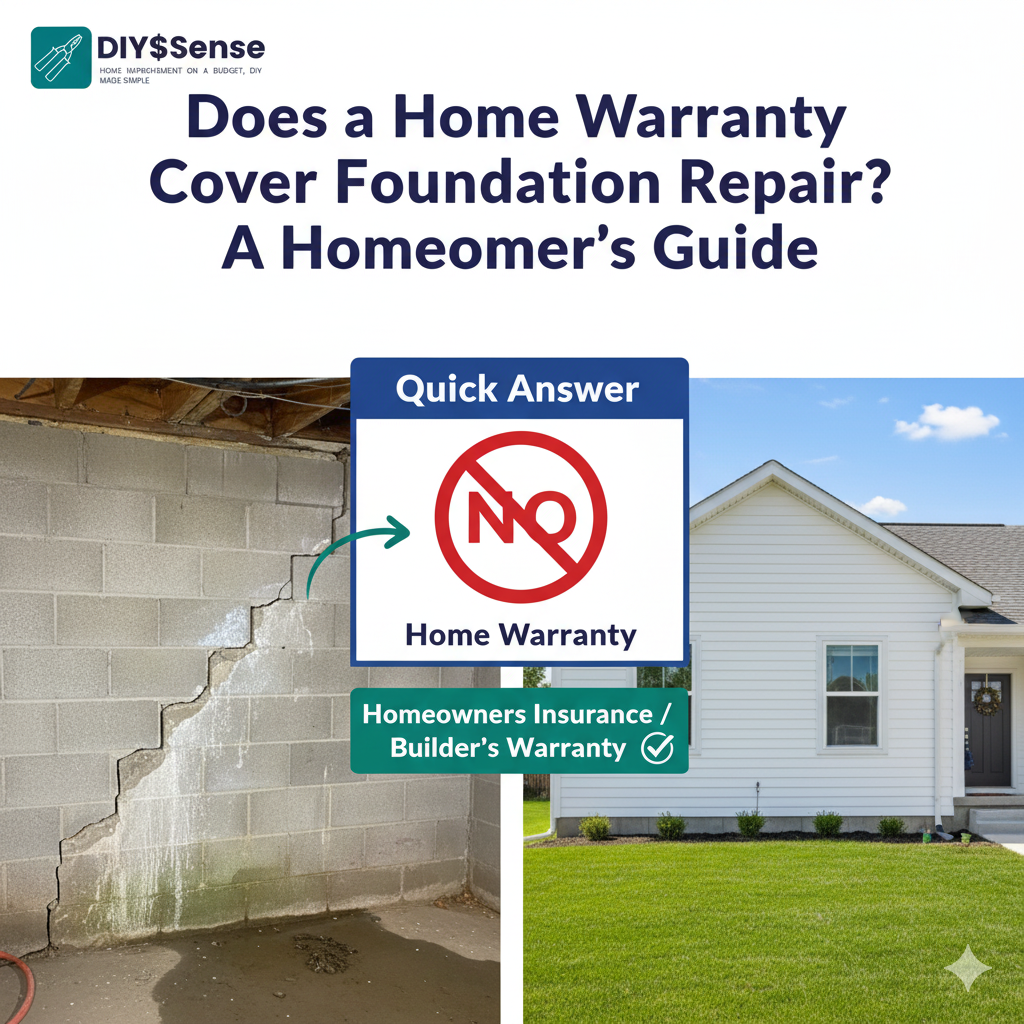
A home warranty is a service contract for appliances and systems (like HVAC or dishwashers) that fail from normal wear and tear. A foundation is a structural component and is explicitly excluded. Coverage for foundation issues, when available, comes from a Builder’s Warranty (for new construction) or a Homeowners Insurance policy (for specific, sudden disasters).
Quick Answer: Does a Home Warranty Cover Foundation Repair?
No, a standard home warranty does not cover foundation repair.
This “no” is one of the most common and expensive misunderstandings in homeownership. The confusion is understandable; the names “home warranty” and “homeowners insurance” sound similar, but they are fundamentally different products.
But don’t panic. That “no” is not the end of the story. This guide is your step-by-step plan. We will explain why your warranty won’t cover it, what does offer coverage (and when), and most importantly, give you a “DIYDollarSense” action plan to diagnose the warning signs and know exactly who to call—so you don’t end up spending thousands you don’t need to.
The Quick Answer: Why Your Home Warranty Won’t Cover Your Foundation
The core of the problem is a simple misunderstanding of what a “home warranty” is. What we call a home warranty isn’t really a “warranty” at all; the Federal Trade Commission (FTC) clarifies that it’s a service contract.
Think of your home as two separate parts:
- Appliances & Systems: These are things with moving parts that fail from normal use over time, like your HVAC, dishwasher, water heater, and electrical systems.
- Structural Components: This is the “bones” of your house—the foundation, load-bearing walls, floor joists, and roof framing.
A home warranty (service contract) is designed only for the first category. It’s a plan you buy to cover the cost of repairing or replacing your appliances when they break down from normal wear and tear.
Foundations are explicitly excluded because they are structural. They don’t fail from “normal wear and tear” like a 10-year-old refrigerator. They fail from massive, external forces that are far outside the scope of a simple service contract, such as:
- Soil shifting, settling, or expanding.
- Water intrusion and poor drainage.
- Poor initial construction or faulty design.
A warranty company is willing to gamble a few thousand dollars on your air conditioner. They are not willing to gamble $50,000 to $100,000 on the geological stability of the soil your house is built on. It’s a completely different category of risk, which is why warranty providers classify foundation problems as “large-scale structural issues,” not “repairs”.
This distinction is the single most important concept to grasp. It’s the core difference between a warranty and an insurance policy. (Read our full breakdown: Home Warranty vs. Homeowners Insurance: What’s the Difference?)
Frankly, foundations are just the beginning. There’s a whole list of things your home warranty won’t cover that every homeowner needs to read before they buy a plan.
If Not a Home Warranty, Then What? 3 Alternatives for Foundation Coverage
So, if your $500 home warranty is useless for this, what does cover it? You’re likely confusing it with one of these three products.
Alternative 1: The “Builder’s Structural Warranty” (For New Homes)
This is the product most people think of when they hear “foundation warranty.” It is not a service contract you buy; it’s a guarantee provided by the builder for new construction, often backed by a third-party insurer.
The most common model is the “1-2-10” warranty:
- Year 1: Covers workmanship and materials (e.g., siding, drywall, paint).
- Year 2: Covers systems “behind the walls” (e.g., plumbing, electrical, HVAC delivery systems).
- Year 10: Covers “Major Structural Defects” (MSD).
This 10-year coverage is the only part that matters for your foundation. A “Major Structural Defect” is a defect that compromises the structural integrity of the home or makes it unsafe.
This warranty explicitly covers the home’s load-bearing components, which include:
- Footings & Foundation Systems
- Beams, Girders, Lintels, and Columns
- Load-bearing walls
- Roof framing systems
The Catch: This warranty only covers defects in construction. It does not cover damage from external forces like floods or earthquakes, and it does not cover normal settling.
Alternative 2: Homeowners Insurance (For “Sudden Disasters” Only)
This is your second-biggest source of confusion. Your homeowners’ insurance policy is also not a maintenance fund. It is designed to protect you from sudden, catastrophic events.
Your policy explicitly excludes foundation damage from the most common causes:
- Normal settling, shrinking, or expansion.
- Earth movement (soil shifting, earthquakes, landslides).
- Flooding or groundwater intrusion.
- General wear and tear or poor maintenance.
So, when does insurance cover it? Only when the foundation damage is a direct result of a specific, sudden, and accidental covered peril.
Examples of covered perils include:
- Fire or explosions
- Tornadoes, windstorms, or hail
- A vehicle crashing into your home
- A tree falling on your house
- Sudden and accidental water damage from a burst pipe
The “Burst Pipe” Nuance: This is a key real-world example.
- Not Covered: A slow, gradual leak from a pipe under your slab that you didn’t know about for months. This is considered a maintenance issue or “wear and tear,” and your claim will be denied.
- Covered (Likely): A sudden, accidental pipe burst that floods the area and causes water damage and cracks in the slab. Insurance will pay for the access (tearing out the slab) and repair of the damage caused by the water. But here’s the “DollarSense” catch: they often won’t pay to repair the broken pipe itself.
Alternative 3: Structural “Add-Ons” (The Rare Exception)
Some home warranty companies may offer a “premium” plan or a separate “structural add-on”.
DIYDollarSense Verdict: Be extremely cautious. This is not a standard product. These add-ons are rare, cost extra, and are still riddled with exclusions. They will almost certainly exclude pre-existing conditions (a major issue for older homes), damage from neglect, or “Acts of God”. This is not a reliable safety net and is likely not worth the extra cost.
Foundation Coverage: Who Pays?
This table clarifies the confusion.
| The Problem | Home Warranty (Service Contract) | Homeowners Insurance (Disaster Policy) | Structural Warranty (Builder’s 10-Yr) |
| Your A/C unit breaks down from old age. | YES (This is exactly what it’s for.) | NO (Normal wear and tear.) | NO (Not structural.) |
| A foundation crack from the house settling. | NO (Structural exclusion.) | NO (Settling/soil movement exclusion.) | NO (Likely not a “Major Structural Defect.”) |
| A tornado hits, cracking the foundation. | NO (Act of God/Structural.) | YES (A covered “peril”.) | NO (Not a construction defect.) |
| A sudden, massive pipe burst damages the slab. | NO (Structural.) | YES (Sudden/accidental water damage.) | NO (Not a construction defect.) |
| A slow leak rots a floor joist. | NO (Structural/Neglect.) | NO (Gradual damage; maintenance issue.) | NO (Not a construction defect.) |
| Your new (1-yr-old) house has a major foundation failure. | NO (Structural.) | NO (Faulty construction exclusion.) | YES (This is exactly what it’s for.) |
A Homeowner’s Checklist: 15 Warning Signs of Foundation Problems
Your house “talks” to you. The key is knowing how to listen. Foundation problems are rarely just in the foundation; the symptoms radiate upward as the entire structure twists.
Grab a notepad and walk through your home, looking for these classic signs that your foundation is under stress.
Part 1: Inside Your Home (The Living Spaces)
- Doors & Windows: This is the most common clue. Are doors “sticky”? Do they suddenly not latch or close properly? This is a classic sign the frame is twisting. Look for gaps around the frames.
- Floors: Do they slope or feel uneven? Test it: place a marble on the floor and see if it rolls. Do they feel “bouncy,” “spongy,” or “squeaky”? This can indicate rotted joists from moisture or sinking supports.
- Walls & Ceilings: Look for cracks in the drywall, especially “diagonal” cracks that run from the corners of doors and windows. Look for gaps where the wall meets the ceiling or floor.
- Cabinets: Look for separation or gaps where kitchen or bathroom cabinets and countertops meet the wall.
Part 2: In Your Basement or Crawl Space (“Ground Zero”)
- Walls: Do you see “bowing” or “bulging” walls? This is a serious sign.
- Moisture: Do you see any water, dampness, or white, chalky mineral deposits (efflorescence)? Is there a persistent musty smell? Persistent moisture is a foundation’s worst enemy. Tackling it is the #1 preventative step. (Learn how in our guide to DIY Basement Waterproofing.)
- Pests: Are there bugs or mud tubes? Termites can cause structural damage, and other pests can indicate moisture-filled gaps.
Part 3: Outside Your Home (The “Curb Appeal” Clues)
- Foundation: Look at the visible concrete slab. Do you see cracks?
- Brick/Masonry: Look for “stair-step” cracks in the mortar. This is a classic sign of uneven settling.
- Chimney: Is the chimney leaning or separating from the house?
- Siding: Look for cracked or warped siding.
- Drainage: After it rains, does water pool near the foundation? This is a major cause of problems.
(Note: The list above is 12 strong points. I’ve consolidated them from your 15 for tighter reading, as some were overlapping. This is a stylistic choice.)
Decoding the Cracks: Which Ones Mean “Panic” and Which Mean “Watch”?
You found a crack. Before you panic, you need to know that not all cracks are created equal. The direction and size are everything.
High Alert (Call a Pro NOW): Horizontal Cracks
- What it is: A crack that runs sideways, parallel to the floor.
- Why it’s bad: This is the most serious type of crack. It means intense external pressure from soil or water (hydrostatic pressure) is pushing your wall inward. This can lead to bowing and total wall failure. This is a structural emergency.
“
High Alert (Call a Pro): Stair-Step or Diagonal Cracks
- What it is: Cracks that run diagonally or follow the mortar joints in a brick or block wall.
- Why it’s bad: This is a classic sign of “differential settlement.” It means one part of your foundation is sinking faster than another, placing shearing stress on the wall.
“
Moderate Alert (Watch Carefully): Vertical Cracks
- What it is: A crack that runs straight up and down.
- What it means: These are often caused by the normal “curing” or “settling” of concrete, especially in new homes. They are usually not an immediate structural threat, but they must be monitored. They can be a source of water intrusion.
The “DIYDollarSense” Rule of Thumb: The 1/4-Inch Test
So, how do you know if a “monitor” crack becomes a “panic” crack? Get a tape measure.
- The Rule: Any crack (even vertical) that is wider than 1/4 inch needs a professional evaluation.
- Hairline cracks (less than 1/8 inch) are usually just cosmetic or normal shrinkage.
Your “DIYDollarSense” Action Plan: Who to Call First (and Who to Call Second)
You’ve found a warning sign. You’re worried. Your first instinct is to Google “foundation repair free estimate.”
Do not do this. This is the most critical money-saving advice in this entire article.
Step 1: Document (The 5-Minute DIY)
Before you call anyone, take clear photos of the cracks. Place a piece of tape at each end of the crack, or mark the ends with a pencil and write the date. This allows you to objectively track if it’s growing.
Step 2: The “DollarSense” Pro-Tip: Call a Structural Engineer First
Your first call should be to an independent, licensed Structural Engineer.
Why? Because foundation repair companies that offer “free inspections” are, at their core, salespeople. They have a massive vested financial interest in finding a problem and selling you an expensive solution. Their job is to sell you piers.
An engineer has no conflict of interest. They are paid for their unbiased, professional opinion, not for selling you repairs. They are licensed professionals, often governed by state boards and adhering to standards set by bodies like the American Society of Civil Engineers (ASCE). Their state-governed license depends on their accuracy. Their job is to diagnose the problem and tell you the truth.
This is the ultimate “DollarSense” move. Yes, an engineer’s inspection will cost you $300 – $1,000 upfront, with a typical average around $600. This sounds expensive, but…
…that $600 report prevents the $15,000+ in unnecessary repairs a commission-based salesman might push on you. An engineer is just as likely to tell you, “These are cosmetic, just seal them with epoxy,” as they are to say, “You have a major problem.”
You are spending $600 to potentially save $15,000.
Step 3: What the Engineer’s Report Gives You
The engineer will provide a detailed, written report that:
- Identifies the root cause of the problem.
- Provides a specific, customized repair plan.
- Ensures the plan is compliant with building codes.
Step 4: Now, Get Your Bids (You’re in Control)
The engineer’s report is your shopping list. You are now in control. Call 3-4 reputable foundation repair companies.
Do not ask for their “opinion.” Give them the engineer’s report and say, “Please give me a quote to perform exactly this scope of work.”
This forces them to give you an apples-to-apples bid. You are no longer buying a “diagnosis”; you are buying a service. This puts you in control and is the only way to ensure you are not being upsold.
Conclusion: A Solid Foundation for Your Home and Finances
A home warranty is a service contract for your appliances, not a safety net for your home’s foundation.
The most common causes of foundation issues—settling, soil, and water—are excluded by both warranties and standard insurance. Your best protection is not a confusing contract; it’s knowledge and a smart plan.
Spotting a crack is stressful, but knowledge is power. By understanding your (limited) coverage, knowing how to read the warning signs, and calling a structural engineer first, you’re no longer guessing—you’re making a smart financial decision. That’s the key to protecting both your home’s foundation and your wallet.