When you find a crack in your foundation or notice a door suddenly sticking, a jolt of financial panic is a common reaction. The average cost for foundation repairs can easily exceed $5,000, with major issues running into the tens of thousands. Your first thought is likely, “Am I covered?” You bought a home warranty, so that should pay for it, right?
Here is the fast answer you are looking for, and it is not the one you want to hear.
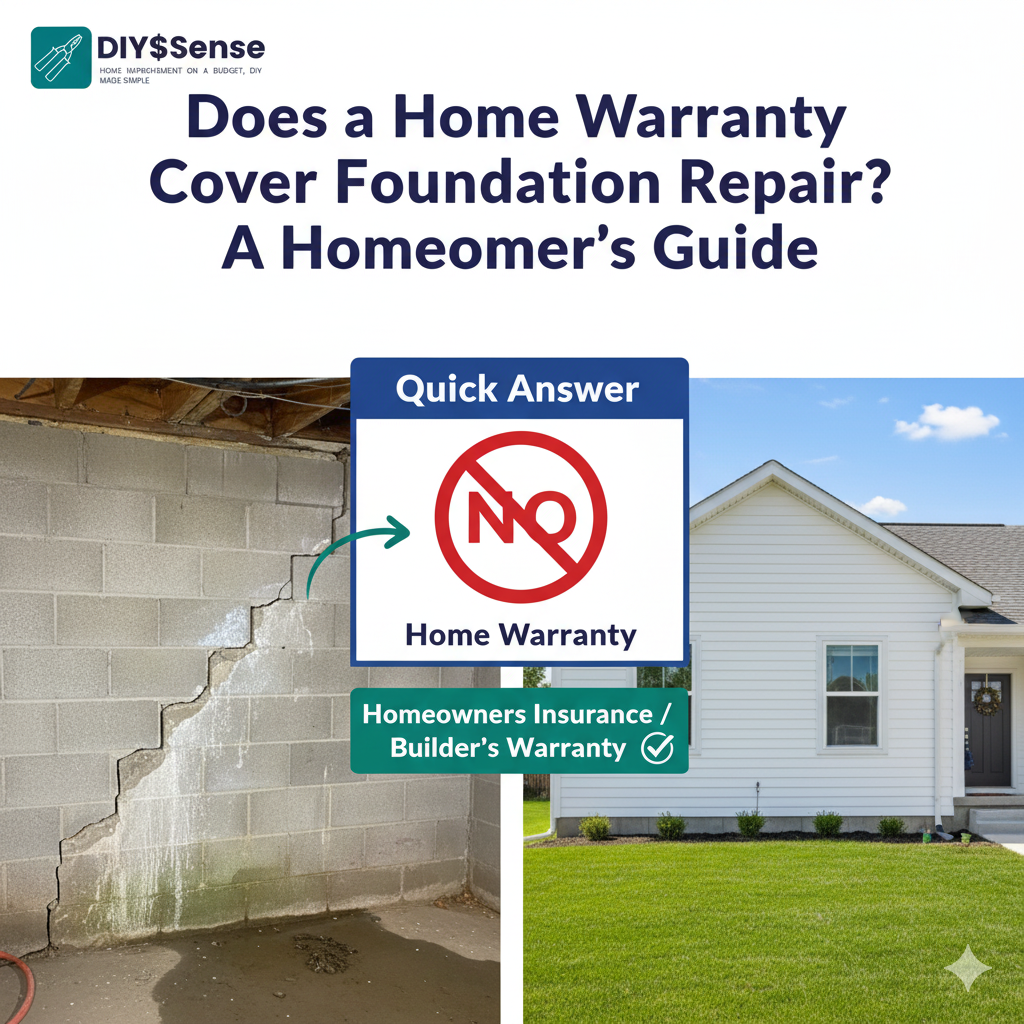
No, a standard home warranty does not cover foundation repair.
This is one of the most significant and costly misunderstandings in homeownership. A home warranty is a service contract, and your home’s foundation is almost universally excluded from these plans.
The confusion is understandable. Homeowners are often juggling three different types of “protection,” all of which sound similar: a home warranty, homeowner’s insurance, and (for new builds) a builder’s warranty. Each product is for a completely different purpose, and assuming one covers the others’ gaps is a multi-thousand-dollar mistake.
This report will explain why your warranty won’t pay, what policies might cover the damage, and—most importantly—what you can do to identify and prevent problems yourself.
Part 1: Why Your Home Warranty Won’t Pay for Foundation Repair
To understand the “why,” you have to understand what a home warranty is actually designed for. The entire business model is based on a fundamental divide between your home’s “systems” and its “structure.”
The Wear and Tear vs. Structural Divide
A home warranty (more accurately called a “home service contract”) is an optional policy you buy to offset the repair or replacement costs of your home’s systems and appliances when they fail from normal wear and tear.
Think of it this way: a home warranty is for things that are expected to break eventually. Your HVAC system, water heater, refrigerator, dishwasher, and plumbing systems all have moving parts and a limited lifespan. They “wear out” from use. A home warranty is designed to cover those expected failures.
Your foundation is not an appliance. It is a structural component of your home, in the same category as your roof, load-bearing walls, and floor framing. These are the “bones” of your house. They are not expected to fail, and if they do, it is not from “normal wear and tear.” Standard home warranty contracts explicitly exclude these structural elements.
What Your Contract Actually Excludes
Warranty providers categorize foundation repairs as large-scale structural issues, not standard maintenance or appliance repair. When a foundation fails, it is almost always due to powerful external forces, not internal failure. The most common causes include:
- Soil shifting, expanding, or settling
- Water intrusion and poor drainage
- Hydrostatic pressure (water pushing against the walls)
- Poor initial construction or compaction
- Damage from tree roots
Because these are not classified as “normal system failures,” most warranty companies exclude them entirely. Foundation repair is one of the most significant items **(future pillar), alongside other common exclusions like roofs, windows, pest damage, and pre-existing conditions.
The One, Tiny (and Unlikely) Exception
In very rare cases, a home warranty might get involved if the foundation damage is a direct result of another covered system’s failure. For example, some plans might offer limited protection if a plumbing leak—a system the warranty does cover—is the proven cause of the foundation issue.
However, this is a dangerous assumption. Many warranty contracts explicitly exclude secondary damage. This means that while they might pay for the service call to fix the leaking pipe (minus your service fee), they will not pay for the thousands of dollars in foundation damage that the leak caused.
The “Dollars and Sense” takeaway is this: The true value of a home warranty in this scenario is not that it will pay for the foundation repair (it won’t), but that it can help you get the plumbing leak fixed quickly and affordably before it has time to cause catastrophic structural damage.
Part 2: The 3 Policies That Might Cover Your Foundation
If your home warranty is the wrong tool, what is the right one? Here are the three policies that can offer protection for your foundation, all in very different circumstances.
1. Homeowner’s Insurance: For Sudden Peril Only
This is the biggest point of confusion, and understanding the difference between **(Article #1) is the first step to protecting your finances.
Unlike a home warranty (which covers wear and tear), a homeowner’s insurance policy covers sudden and accidental events, also known as “perils”.
- What’s Covered: Your insurance might cover foundation repair only if the damage is the direct result of a specific, covered peril listed in your policy. These can include:
- Fire
- Explosion (e.g., from a gas leak)
- A vehicle crashing into your home
- A falling tree
- A sudden and accidental plumbing break, like a burst pipe
- What’s NOT Covered: This is the most important part. Homeowner’s insurance explicitly excludes the most common causes of foundation failure. These exclusions typically include:
- Normal settling, shifting, or cracking over time
- Earth movement (this is the big one, which includes earthquakes, landslides, and shifting soil, unless you buy a separate rider)
- Floods (this requires a separate flood insurance policy, which also may not cover soil-related damage)
- Poor construction, faulty materials, or neglect
- Damage from tree roots or pests
This creates a terrifying “coverage gap.” The most likely causes of foundation failure—gradual settling and water-saturated soil—are excluded by both your home warranty (because it’s structural) and your homeowner’s insurance (because it’s “earth movement” and not sudden).
2. Builder’s Warranties: The 1-2-10 New Home Guarantee
If you purchased a newly built home, you are likely covered by a builder’s warranty. This is not a home warranty; it is a guarantee provided by the builder against defects in construction.
These are most often structured as “1-2-10” warranties:
- Year 1: Covers workmanship and materials. This includes things like paint, trim, drywall, and siding.
- Year 2: Covers major systems (defects in installation). This includes your plumbing, electrical, and HVAC systems.
- Years 1-10: Covers Major Structural Defects (MSD).
That 10-year structural warranty is the one that matters. It is designed to cover the home’s load-bearing elements, and it explicitly includes the foundation.
However, the key phrase is “Major Structural Defect.” This is not for a minor hairline crack. An MSD is typically defined as a defect that makes the home unsafe, unsanitary, or unlivable. A “roof that could collapse” is a common example. For your foundation, this means settlement beyond industry tolerances, not a door that sticks in year seven.
3. Standalone Structural Warranties: The Niche Solution
Finally, there are specialized, standalone structural warranties. These are insurance-backed policies that only cover the load-bearing components of a home.
Some home warranty companies may offer this as a rare, expensive add-on to their highest-tier plans. More often, these are third-party policies that can be purchased separately.
However, there is a major catch. While common for new builds (builders buy them to transfer their 10-year risk), these policies are “less common” and “more expensive” for existing, older homes. The reason is simple: risk. The older a home gets, the higher the risk of a claim. Insurers know that a homeowner seeking this niche policy for a 30-year-old house probably already suspects a problem, so they price the policy accordingly or exclude any pre-existing conditions.
For most homeowners with an existing home, this is not a practical or affordable option. Your money is almost always better spent on prevention.
Part 3: A Homeowner’s Action Guide to Foundation Health
Since most warranties and insurance policies won’t protect you, your best financial tool is knowledge and prevention. This is the “DIY” part of “DIY Dollar Sense.” You need to learn how to spot early warning signs and how to manage the one thing that is attacking your home: water.
The DIY Foundation Inspection Checklist (What to Look For)
Foundation problems are stressful, but they rarely happen overnight. They “whisper” through subtle signs long before they “shout” with a catastrophic failure. Use this checklist to triage what you are seeing.
| Location | Warning Sign | What to Look For (The “Bad” Signs) | “Dollars and Sense” Action |
| Inside the Home | Wall Cracks | Diagonal, “stair-step” cracks running from corners of doors/windows. | Monitor: Hairline vertical cracks (common settling). Call Pro: Any crack wider than 1/4 inch or growing. |
| Sticking Doors & Windows | Doors jam, won’t latch, or have uneven gaps at the top. | Monitor: If it only happens in humid summer months. Call Pro: If it’s new, persistent, and combined with other signs on this list. | |
| Floors | Floors feel sloped, bouncy, or uneven. A marble rolls on its own. | Monitor: Minor squeaks. Call Pro: Any noticeable sloping, sagging, or bounciness. | |
| Gaps | Cabinets, counters, or trim separating from the wall. | Call Pro: This is a clear sign of structural movement. | |
| Outside the Home | Foundation Cracks | Horizontal cracks (very serious), or wide “stair-step” cracks in brick. | Call Pro: Any horizontal crack. Any vertical crack wider than 1/4 inch. |
| Structural Separation | Leaning or separating chimney. Gaps between porch/stairs and the main house. | Call Pro: These are high-priority signs of uneven settling. | |
| Siding/Roof | Warped or cracked siding. A visibly uneven or sagging roofline. | Call Pro: This indicates the entire frame is being compromised. | |
| Basement / Crawlspace | Bowing Walls | Walls that lean or bulge inward. | Call Pro IMMEDIATELY: This is a sign of extreme external pressure and potential imminent failure. |
| Water & Moisture | Persistent dampness, musty smells, or active water intrusion. | Call Pro: This is the cause of the problem. Fix the water, save the foundation. |
What’s Really Attacking Your Home? (The Root Cause)
You now know what to look for. Now you need to understand why it’s happening. The warning signs above are just symptoms. The disease, in most of the U.S., is a combination of two things: bad soil and water.
- Expansive (Clay) Soil: This type of soil is a primary geologic hazard. It acts like a sponge. When it absorbs water, it can swell in volume by 10% or more, putting enormous lateral (sideways) pressure on your foundation walls, causing them to crack and bow. When this soil dries out, it shrinks, creating gaps that can cause your foundation to settle unevenly.
- Hydrostatic Pressure: This is the pressure of standing water in saturated soil. When water accumulates against your foundation, it wants to expand and push into your basement or crawlspace. Your foundation walls are built to handle vertical (top-down) weight from your house, not lateral (sideways) pressure from thousands of pounds of water. This is often made worse by the “clay bowl effect,” where the loose backfill soil around your home traps water like a moat.
This is the “ah-ha!” moment. Now you understand why the coverage gap exists. Warranties exclude “external factors”. Insurance excludes “earth movement” and “water damage from settling”. Both are describing the very nature of foundation failure.
Your First Line of Defense: DIY Water Management
Since water is the primary enemy, your #1 prevention strategy is to control and redirect it. This is the best, cheapest financial protection you can buy. Many of these steps are the core of a good **(future) strategy.
- 1. Clean Your Gutters: This is the simplest and most important job. Clogged gutters overflow, dumping hundreds of gallons of water directly at the base of your foundation—the single worst place for it to be.
- 2. Extend Your Downspouts: Walk around your house. Do your downspouts just dump water right next to the wall? This is a major cause of foundation problems. Buy simple, cheap extensions to ensure all water is discharged at least 10 feet away from your home.
- 3. Check Your Grading: The soil around your foundation must slope away from the house to drain water naturally. If the soil is flat or, even worse, slopes toward your house (negative grading), you are funneling water directly to your foundation. You may need to add dense soil (like clay, not mulch) to build up the grade.
An hour of gutter cleaning or $50 spent on downspout extensions can save you from a $10,000 repair bill. That is the essence of “DIY Dollar Sense.”
Conclusion: Stop Worrying, Start Monitoring
Let’s circle back to the core question. A home warranty is a valuable tool for managing a predictable budget for appliance repairs, but it offers zero protection for your home’s foundation.
- A Home Warranty is a service contract for appliances that fail from wear and tear. Your foundation is neither.
- Homeowner’s Insurance is for sudden disasters. It excludes the common, gradual causes of foundation failure like settling and soil movement.
- A Builder’s Warranty does cover the foundation, but only for new homes and only for major structural defects.
If you see the warning signs from the checklist, don’t waste time calling your warranty company. They will deny the claim.
Your best financial move is to call an independent structural engineer. A foundation repair company may offer a “free estimate,” but they have a vested interest in selling you a repair. An engineer charges a flat fee ($500-$800) for an unbiased diagnosis. They will tell you if the crack is a cosmetic issue, a problem to monitor, or something that needs immediate repair. That unbiased report is the most valuable financial protection you can get.