The problem with most organization advice is it assumes you have space to work with. These 47 hacks are built specifically for small homes — apartments, mobile homes, starter houses — where every single inch counts. No buying a bigger house. No expensive built-ins. Just smart, affordable systems that work in real small spaces.
We’ve grouped everything room by room so you can tackle one area at a time without getting overwhelmed. Pick the room that stresses you out the most and start there.
Kitchen Organization Hacks (1–12)
Small kitchens lose the most space to bad habits — horizontal stacking, ignored cabinet doors, and empty walls. These 12 hacks fix all of that without a single renovation.
Use Tension Rods Vertically in Cabinets for Baking Sheets
Measure the internal height of a lower cabinet and insert 3–4 short tension rods vertically, spaced about 2 inches apart. Cutting boards, baking sheets, and sheet pans now stand upright like files in a drawer — grab one without moving everything else. This single change from horizontal stacking to vertical filing is the biggest small-kitchen upgrade you can make for under $15.
Mount a Magnetic Knife Strip on the Wall
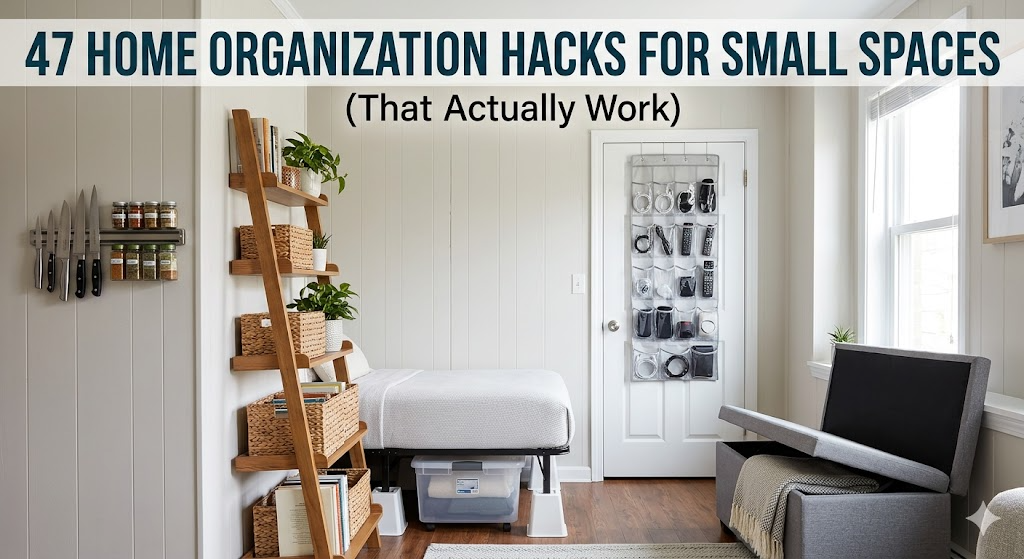
A 16-inch magnetic steel bar screwed directly into the wall holds every knife you own and frees up an entire kitchen drawer instantly. Most strips hold 8–12 knives. Mount it at eye level next to the prep area — knives are visible, accessible, and safer than loose in a drawer. This is one of the single highest-impact, lowest-cost swaps in any small kitchen.
Stack Pots with Pan Protectors Between Them
Soft felt or silicone pan protector discs slip between stacked pots and pans to prevent scratching — so you can safely nest every piece of cookware into one compact tower. No more pulling out four pans to reach the one at the bottom. A set of 12 protectors costs under $12 and lets you reclaim 60% of the cabinet space that messy pot stacking wastes.
Mount Small Shelves on the Inside of Cabinet Doors
The interior face of every cabinet door is completely empty in most kitchens. Screw slim wire or acrylic racks to the inside of upper cabinet doors to hold spice jars, foil boxes, and cling wrap — items that otherwise eat up prime shelf space inside. A two-pack of door-mount spice racks costs around $14 and creates storage from a surface nobody was using.
Decant Dry Goods into Clear Stackable Containers
Transfer pasta, rice, oats, flour, and cereal from bulky, awkward bags and boxes into uniform, clear, airtight stackable containers. The difference in storage density is enormous — irregular packaging wastes 40% of shelf space. When everything is the same shape and stackable, you can store twice the food in the same cabinet. Sets of 12 range from $25–$45 and pay for themselves immediately.
Add a Pegboard Backsplash for Hanging Utensils
Mount a painted pegboard panel to the wall between your countertop and upper cabinets. Hang pots, utensils, a paper towel roll, small shelves, and even a magnetic strip — all on one panel. This converts dead wall space into a fully functional tool wall and clears out two or three drawers overnight. A 2×4-foot panel costs around $20 and takes under an hour to install.
Use a Tension Rod Under the Sink to Hang Spray Bottles
Install one tension rod across the interior of your under-sink cabinet about 6 inches from the top. Hang all your spray bottles by their trigger handles from the rod — they’re now suspended in mid-air instead of cluttering the shelf floor. The space below opens up completely for bins or a lazy Susan. Cost: under $8. Time: two minutes.
Turntable (Lazy Susan) in Corner Cabinets
Corner cabinets are notorious dead zones — things disappear into the back and never come out. A two-tiered turntable spun inside a corner cabinet eliminates this entirely. Load the inner ring with taller bottles and the outer ring with smaller jars — everything rotates to the front with one spin. A quality unit costs $22 and is the single most effective fix for the notoriously wasted cabinet corner.
Magnetic Spice Jars on the Fridge Side
The exposed side panel of most refrigerators is a completely unused metal surface. Heavy-duty neodymium magnetic spice tins or a magnetic shelf unit adhered to the fridge side instantly creates a mini spice rack from dead space. It takes every daily spice completely off the counter and out of the cabinet. Units cost around $35–$45 and require zero drilling or permanent installation.
Drawer Dividers for Utensils — End the Junk Drawer
Expandable bamboo or plastic drawer dividers create fixed compartments inside a utensil drawer so everything has a specific slot. No more rummaging through a tangled mess to find a peeler. When every item has its own section, the drawer holds twice as much and you find things in seconds. A quality expandable set costs $8–$15 and fits any drawer width.
Over-Fridge Shelf for Rarely Used Items
The top of the refrigerator is typically a flat surface used as a dumping ground. Replace the clutter with a purpose-built over-fridge shelf that adds an additional organized storage tier for bulky items like the air fryer, large mixing bowls, or the coffee maker. At around $30–$50, it channels the top of the fridge from chaos into intentional storage without touching a single cabinet.
Command Hooks on the Pantry Wall for Measuring Cups
Stick three or four large Command hooks to the interior wall of your pantry closet and hang measuring cups, oven mitts, and pot holders on them. Items that usually clutter drawers are now hung and instantly visible. Command hooks hold up to 7.5 lbs each, leave zero wall damage, and cost about $10 for a value pack. Works equally well on VOG panels in mobile homes — no drilling required.


Bedroom Organization Hacks (13–22)
Small bedrooms have two huge untapped storage zones most people completely ignore: the space under the bed and the back of the door. These 10 hacks put both to work.
Under-Bed Storage Bins — The Most Underused Space in Any Bedroom
The footprint of a queen bed is 60 square feet of floor space — and most people store nothing under it. Flat, lidded bins on wheels that slide easily under the frame are perfect for off-season clothes, extra linens, and shoes. Measure your bed’s clearance height before buying. Rolling bins with handles make retrieval easy and cost $15–$30 each.
Bed Risers — Lift 6 Inches, Double Your Under-Bed Storage
If your current bed sits too low to fit storage bins, screw-in or stacking bed risers lift the entire frame 3–8 inches. This creates enough clearance for a full wardrobe worth of flat storage bins. A set of four heavy-duty risers costs around $20–$30 and supports up to 1,200 lbs. One of the cheapest ways to gain an entire closet’s worth of space.
Over-Door Shoe Organizer — Not Just for Shoes
Hang a clear vinyl multi-pocket organizer on the back of your bedroom or closet door and use it for anything small — accessories, belts, chargers, vitamins, cleaning supplies, or craft supplies. The transparent pockets mean zero visual searching. A standard 24-pocket organizer costs $12–$18 and converts the completely unused back of a door into a high-density filing wall.
Floating Nightstand Shelves — Replace Bulky Bedside Tables
A wall-mounted floating shelf with a lip replaces a traditional nightstand completely — same function, zero floor footprint. The continuous, unbroken floor plane below makes the room feel dramatically larger. Mount two brackets into studs, attach a 10×18-inch shelf, and you have a lamp surface, phone charger spot, and book storage for around $40–$60. Works on standard drywall and most manufactured home walls.
Closet Doubler Rod — Hang a Second Rail Below the First
A closet doubler is a second hanging rod that suspends below your existing one, specifically for short items — shirts, folded pants, jackets. In one move, you turn one hanging row into two. The 40 inches of empty space below hanging shirts in most closets is the biggest wasted zone in any bedroom. A quality adjustable doubler costs $15–$25 and requires no tools or hardware.
Vacuum Storage Bags for Seasonal Clothes
Heavy winter coats, bulky sweaters, and thick duvets take up enormous closet space nine months a year. Vacuum storage bags compress soft goods by up to 80% — a full winter wardrobe that fills an entire shelf condenses to the size of a small suitcase. Use a standard vacuum cleaner hose on the one-way valve and store the flat bags under the bed. Jumbo 6-packs cost around $32.
Drawer Dividers + File-Fold Method — See Everything at Once
Combined with drawer dividers, the file-fold (KonMari) method stands folded clothes upright like files in a filing cabinet instead of stacking them. You can see every item at a glance without disturbing the pile. One drawer holds 40% more clothing this way, and nothing gets buried. Drawer dividers for a typical 3-drawer dresser cost $20–$35 total.
Hooks on the Back of the Bedroom Door
Four Command hooks on the back of your bedroom door handle tomorrow’s outfit, your bathrobe, daily bags, and gym clothes — items that otherwise end up on the floor or draped over a chair. Each hook costs under $3 and holds 7.5 lbs. No damage to the door, easy to reposition, and works perfectly on hollow-core doors in apartments and mobile homes.
Clear Stackable Shoe Boxes — See Everything, Stack to the Ceiling
Standard shoe boxes are opaque, non-uniform, and collapse under stacking. Clear drop-front acrylic boxes show you exactly what’s inside, stack securely, and can reach ceiling height in a closet. You’ll spend about $3–$5 per box — a 12-box tower costs $36–$60 and creates a proper shoe library in the footprint of two standard shoe boxes laid flat.
Slim Velvet Hangers — Replace Bulky Plastic Ones
Standard plastic hangers are 1–1.5 inches thick. Slim velvet hangers are 0.2 inches thick. Replace 20 plastic hangers with velvet and you instantly free up 24 inches of closet rod — enough room for 12 more garments. They also grip fabric so nothing slides off. A 50-pack of quality velvet hangers runs $20–$28 and doubles usable closet rod space overnight.


Bathroom Organization Hacks (23–31)
Small bathrooms have almost no flat surface area — which means vertical space and door backs are your only options. Here’s how to use them properly.
Tension Rod Under the Sink to Hang Spray Bottles
Same as the kitchen version — install a tension rod inside the under-sink cabinet and hang spray bottles by their triggers. The floor of the cabinet opens up completely for labelled bins. Two minutes, under $8, and the under-sink area transforms from a chaotic pile into a fully organized cleaning station. Add a second rod for even more hanging storage.
Magnetic Strip Inside Medicine Cabinet for Bobby Pins
Stick a self-adhesive magnetic strip to the interior back wall of a medicine cabinet. Bobby pins, nail clippers, tweezers, and grooming scissors attach magnetically and are instantly visible and separated from everything else. Cost is under $8. It eliminates the scattered-tiny-items problem that turns medicine cabinets into chaos in about a week.
Over-Toilet Shelving Unit — Completely Unused Vertical Space
A freestanding or wall-anchored etagere that straddles the toilet tank converts the 15 cubic feet of dead air above the toilet into primary storage for towels, toilet paper, and bathroom products. No drilling required for freestanding versions. They cost $60–$120 and are the single most effective way to add bathroom storage without touching the walls in a rented space.
Shower Caddy with Suction Cups — No Drilling Required
Heavy-duty suction caddy systems attach directly to smooth tile or glass without a single hole. Look for caddies rated for 15+ lbs with locking suction mechanisms that won’t drop in the night. They hold shampoo, conditioner, body wash, and razors off the tub edge entirely. Quality caddies cost $20–$40 and are perfect for renters and mobile home bathrooms with thin tile.
Stackable Drawer Organizers for Makeup
Clear acrylic stackable organizer trays with multiple compartments turn a messy makeup drawer into a display-worthy system where every product has a home. You’ll find everything instantly and stop buying duplicates of things you forgot you owned. A starter set for one drawer costs $15–$25. Arrange by category: base, eye, lip, brushes.
Command Hooks on the Shower Wall for Loofahs and Razors
Waterproof Command hooks rated for bathroom use stick to tile, glass, and acrylic and hold up to 3 lbs each. Hang your loofah, razor, and a second hook for a small mesh bag. This moves bulky shower items entirely off the tub ledge where they breed mold. The hooks leave zero residue when removed — critical for renters and VOG-walled mobile homes.
Towel Ladder Instead of a Towel Bar — Holds 3× More
A freestanding ladder leaned against the bathroom wall holds 4–6 towels on its rungs, takes up 12 inches of floor space, and requires zero wall mounting. Traditional towel bars hold one or two items per bar. Wooden or metal ladder towel racks cost $25–$60, add a design element, and can be moved in five seconds when you’re cleaning the floor.
Labelled Bins Under the Sink — First Aid, Hair, Skincare, Cleaning
Divide the under-sink cabinet floor into zones using small open-top bins, one per category. Label them. When something is empty you pull the whole bin to the store instead of forgetting what you need. Open-top bins cost $5–$10 each and eliminate the need to remove everything just to find the item at the back. This one habit prevents under-sink chaos from ever returning.
Over-Door Organizer with Clear Pockets — See Everything Instantly
A multi-pocket clear organizer on the back of the bathroom door holds hair tools, backup products, medicines, and cleaning supplies. Nothing is hidden. You can see every item without opening anything. This is one of the most critical hacks for mobile home bathrooms where thin VOG walls can’t support heavy shelving. Cost: $12–$20. Zero wall damage.


Living Room Organization Hacks (32–38)
Small living rooms need furniture that earns its floor space twice over. Every piece should serve at least two functions. Here’s how to make that happen.
Ottoman with Storage — Replace Your Coffee Table
A hollow upholstered ottoman with a removable lid replaces a coffee table and hides everything inside — throw blankets, board games, kids’ toys, extra pillows. Add a tray on top and it becomes a surface. It also doubles as a footrest and extra seating for guests. Ranges from $80–$200. Every small living room should have one of these instead of a solid coffee table.
Floating Shelves Above the Sofa — Go Vertical Not Horizontal
The 5-foot wall expanse above a sofa is almost always completely blank. Two or three floating shelves here hold books, plants, baskets, and decor without touching the floor plan at all. Anchor into studs for anything heavy. Shelves cost $20–$60 each and transform blank wall space into functional, attractive storage that doubles as the room’s focal point.
Cable Management Box — Hide the Router and Power Strip
A decorative cable management box slides over your router, modem, and power strip completely, leaving only a clean exterior and a slot in the back for cables and heat venting. Costs around $20. Cable clutter is one of the biggest sources of visual noise in a small living room — hiding it in a box takes two minutes and instantly makes the space feel cleaner and calmer.
Basket System on Open Shelves — Everything Has a Home
Open shelving in a small living room looks chaotic unless you use identical baskets as containers. Assign one basket per category: remotes, chargers, mail, kids’ items, craft supplies. From the outside, every shelf looks calm and uniform. The baskets cost $8–$20 each. This system is how professional organizers make open shelving work in small homes without it looking cluttered.
Wall-Mounted TV — Removes the Bulky TV Unit Entirely
A wall-mounted TV on a stud-anchored bracket removes the need for a TV stand completely, freeing 18–24 inches of floor depth and the entire footprint of the furniture piece. Combine this with a slim floating shelf below for the essential electronics. A standard TV mount costs $25–$60. In a small living room this single change makes the room feel like it gained 30 square feet.
Decorative Ladder for Blankets
A wooden or metal decorative ladder leaned against the wall holds 4–5 folded throw blankets on its rungs. It turns a storage function into a decor feature and takes up 12 inches of floor space in a corner that was probably already dead. Costs $30–$80. It looks intentional, requires zero installation, and keeps blankets accessible and off the sofa arm where they create clutter.
Command Hooks Behind the Sofa for Headphones and Chargers
Stick two or three Command hooks to the wall directly behind the sofa — low, just above the sofa back. Hang headphones, a charging cable, and the TV remote on dedicated hooks. Everything you reach for while sitting is exactly where you expect it. Cost: under $10. Zero drilling required. Works on any wall surface including painted VOG paneling in manufactured homes.
Entryway Organization Hacks (39–43)
The entryway is where daily chaos enters your home. Intercept it here and the rest of the house stays organized almost automatically.
Floating Shelf with Hooks Below — Keys, Bags, Mail in 12 Inches of Wall
A wall-mounted shelf with 3–4 hooks mounted beneath it handles everything that enters and exits daily — keys, bags, leashes, headphones, and light jackets. The shelf above holds a small tray for mail and a bowl for wallet and sunglasses. This entire command station takes up about 24 inches of wall and 5 inches of depth. Total cost: $40–$70 installed.
Shoe Bench with Storage Inside — Hide the Chaos
A bench with a hinged lid and hollow interior sits at the door for shoe removal — shoes go inside the bench, not on the floor. It seats one or two people, hides shoes completely, and keeps the entryway looking clean even when it isn’t. Costs $80–$150. For narrow entryways under 4 feet wide, look for 18-inch deep versions that don’t block the door swing.
Wall-Mounted Mail Sorter — Stops Paper Pile-Up Immediately
A 3-slot wall-mounted mail sorter near the door creates a home for incoming mail, bills, and papers the moment they enter. Without a designated landing spot, paper migrates to every flat surface in the house within days. A metal or wooden sorter costs $15–$35 and mounts to any wall. Label slots: To Do, To File, To Read. Papers that have a home stop wandering.
One Hook Per Person — Not One Hook Per Item
Most entryway hooks get overloaded because every family member hangs five items on one hook. Switch the rule: one dedicated hook per person, maximum two items per hook. When the hook is full, something must be moved to the closet. This behavioral constraint prevents the hook area from becoming a layered pile of coats, bags, and scarves that slides off the wall over time.
Small Tray for Keys and Wallet — Decision Fatigue Eliminated
A single ceramic, wooden, or metal tray placed at the exact spot where you naturally empty your pockets eliminates the “where are my keys” problem permanently. The item doesn’t go anywhere — it has one home and only one. Trays cost $10–$30. The key is placement: it must be at the precise location you stand when you come through the door, not where you think it should go.
Mobile and Manufactured Home Specific Hacks (44–47)
Manufactured homes have thinner walls, shallower wall cavities, and VOG paneling that standard anchors will tear right through. These four hacks are built specifically for that reality.
VOG (Vinyl-over-Gypsum) panels in manufactured homes are only 5/16-inch thick — far thinner than standard drywall. Standard drywall anchors will pull right through them. Always use toggle bolts designed for thin paneling, Command strips rated for the load, or floor-to-ceiling tension systems that bypass the wall entirely. When in doubt, anchor into a stud or use adhesive.
Use VOG Panel Seams as Your Stud Guide for Mounting
In manufactured homes, the vertical seams in VOG wall panels are placed exactly over the underlying wall studs. This means every visible panel seam is a map of your stud locations — no stud finder required. When mounting floating shelves or hook rails, align your fasteners with these seams and you’ll hit solid framing every time. This one tip saves mobile home owners from torn-out shelves and failed anchors.
Murphy Bed or Wall Bed — Reclaims an Entire Room in a Single-Wide
A wall-mounted Murphy bed folds completely flat against the wall during the day, converting the bedroom into a full living or workspace. In a single-wide where every square foot matters, this transforms a dedicated bedroom into a dual-purpose room. DIY Murphy bed kits start around $500; pre-built units run $1,000–$2,500. The ROI in a small manufactured home is immediate and dramatic. Anchor the frame into studs, not VOG panels.
Pegboard in the Kitchen — Lightweight and Safe for Thin Walls
A pegboard panel mounted with short standoff spacers is one of the few wall-mounted organizational systems genuinely safe for mobile home walls. The distributed load of dozens of small hooks across a large panel keeps per-stud stress minimal. A 2×4-foot primed pegboard costs around $20. It clears the countertop entirely of utensils and small appliances and works perfectly in the narrow galley kitchens common in manufactured homes.
Floor-to-Ceiling Tension Poles — Zero Wall Damage, Maximum Storage
Heavy-duty tension poles brace between the floor and ceiling with no wall anchoring at all. They support shelves, hooks, and hanging organizers — all without touching the fragile VOG panels. This is the gold standard solution for mobile home renters and owners who need serious storage capacity without wall damage. Units like the Yamazaki Home pole system cost around $145 and hold up to 66 lbs. Requires only a 4-square-inch floor footprint.
Best Organization Products Actually Worth Buying
Most organization products are gimmicks. These six categories solve real, recurring problems in small homes — and the price-to-impact ratio on all of them is excellent.
| Product | Cost | Best Used In |
|---|---|---|
| Over-door organizer (clear pockets) | $12 – $20 | Bedroom, bathroom, pantry door |
| Drawer dividers (expandable) | $8 – $15 | Kitchen, bedroom, bathroom |
| Vacuum storage bags (jumbo) | $25 – $35 | Bedroom closet, under-bed |
| Tension rods (multi-pack) | $8 – $12 | Kitchen, bathroom, closet |
| Command hooks (value pack) | $10 – $15 | Every room, VOG walls safe |
| Clear stackable bins with lids | $20 – $35 | Pantry, under-sink, closet |
How to Actually Stay Organized Long-Term
Organization fails when it relies on willpower. The systems below make staying organized the path of least resistance — no motivation required.
- Every item needs exactly one home. If something doesn’t have a designated spot, it will migrate to every flat surface in the house within a week.
- One-in, one-out rule. Every new item that enters the house requires an old item to leave. Non-negotiable in small spaces.
- 10-minute reset every evening. Not a deep clean — just return everything to its home. This one habit prevents weekend disaster-cleaning sessions.
- Use open-top bins, not lidded containers. The one extra step of removing a lid is enough friction to make people abandon the system entirely. Open bins get used.
- Baskets hide imperfection. When a room is messy but everything is in its basket, it looks intentional. This is the psychological secret of every professionally organized small home.
- Declutter before you buy storage. Most people organize clutter instead of eliminating it. A $45 bin full of things you don’t need is still clutter. Edit first, then contain.
The most organized small homes aren’t organized because the occupants have more willpower. They’re organized because the system makes putting things away easier than leaving them out. Design friction out of your storage and the organization maintains itself.
Frequently Asked Questions
The highest-impact hacks focus on two things: vertical space and multi-function furniture. Floor-to-ceiling tension poles, over-door organizers, and hollow storage ottomans deliver the most storage per dollar in a small home. Combine these with drawer dividers and open-top bins and you eliminate 80% of the clutter problems in a small space without spending more than $150 total.
When built-in storage doesn’t exist, you create it using existing structural boundaries. Ceiling-height perimeter shelving, hydraulic lift beds, over-door matrices, and freestanding modular units are all ways to generate storage capacity without touching the walls or paying for renovations. Floor-to-ceiling tension poles are particularly valuable here — they create a 9-foot storage column from a 4-square-inch floor footprint.
Start with the entryway and kitchen counters. These are the two surfaces that accumulate clutter fastest and whose disorder radiates stress throughout the entire home. Clearing them creates an immediate psychological win that motivates every subsequent step. Set up a wall-mounted command station at the door first, then tackle the kitchen surfaces second.
For most small home situations, no — the hacks in this guide cover the core methodology that professional organizers use. Professional services are worth considering if you’re dealing with hoarding-level accumulation, a major life transition like a move or downsizing, or if you’ve tried organizing multiple times and the systems keep failing. Otherwise, a focused weekend and $100 in products will get you the same result.
Over-door organizers, expandable drawer dividers, tension rods, Command hooks, vacuum storage bags, and clear stackable bins. These six categories solve recurring structural problems in small homes. Avoid single-purpose rigid plastic bins that can’t collapse when empty, and anything marketed as a “space-saver” that adds more visual clutter than it removes.
Build systems that require less effort to use than to ignore. Open-top bins, single-step storage solutions, and a nightly 10-minute reset habit are more effective than any amount of motivation or willpower. The one-in-one-out rule is the most important long-term habit — in a small home, accumulation is the enemy and it compounds silently until it becomes overwhelming.
Start With One Room This Weekend
Pick one room. Set a $30 budget. Pick three hacks from that section and implement them this weekend. Organization is not a one-day project — it’s a series of small wins that compound. The kitchen drawer you finally sort on Saturday leads to the bathroom cabinet on Sunday. Start small, finish the room, then move to the next.
Drop your before-and-after photos in the comments — we love seeing what DIY Dollar$ense readers create with these ideas.