If you’ve moved to Florida from the North, you’ve probably noticed a confusing quirk about Southern homes: nobody has a basement. This can be baffling for those who grew up relying on that extra space for storage, a laundry room, or a storm shelter.
You might hear that it’s “theoretically possible” to build a basement in Florida, but this is like saying it’s “theoretically possible” to build a sandcastle during a hurricane. While technically true, it’s a fight against geology, hydrology, and meteorology that is so impractical and financially ruinous that almost no one does it.
The lack of basements isn’t an oversight; it’s a deliberate and non-negotiable design choice.
Key Takeaways: The Quick Answer
Florida homes don’t have basements due to a combination of three factors:
- A High Water Table: The ground is already saturated with water just a few feet below the surface, making it impossible to dig a dry hole.
- Unstable Soil: The land is mostly porous limestone (prone to sinkholes) or shifting sand, which cannot support a basement’s structure.
- Cost, Codes & Hurricanes: It is prohibitively expensive, legally blocked by flood codes, and lethally dangerous during a hurricane’s storm surge.
Here’s why Florida modular home basements homes are built on-grade, explained by the three primary factors that make digging down a non-starter.
1. The Ground is Already Full of Water (The High Water Table)
The number one reason you won’t find basements in Florida is the state’s extremely high water table.
Florida’s Shallow Water Table
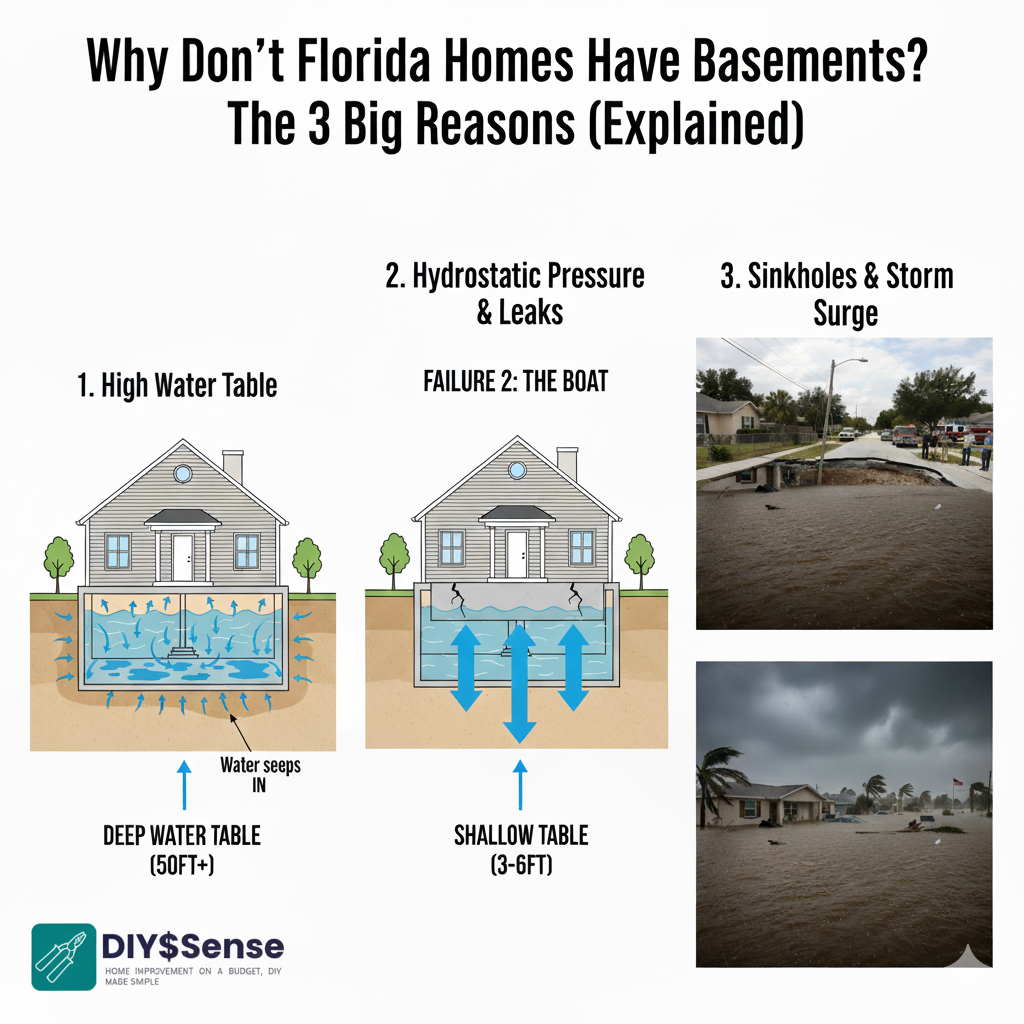
Think of the “water table” as the level in the ground where the soil is permanently saturated with water. In many parts of the country, this water table might be 50 feet or more underground.
In Florida, it’s often just a few feet from the surface.
This is because the entire state is a low-lying peninsula sitting on a massive, productive aquifer system. It’s less like building on solid ground and more like building on a giant, saturated sponge.
A typical basement needs an excavation of at least 8 to 10 feet. This is a complete non-starter when the water table in many parts of Florida is only 2 to 6 feet below the surface, and even shallower in coastal areas during the wet season.
Table 1: Typical Florida Water Table vs. Basement Needs
| Location / Requirement | Required Depth |
| Typical Basement Foundation | 8 – 10 feet |
| Average Water Table (Wet Season) | |
| Coastal Miami-Dade / Broward | 2 – 4 feet |
| Inland Broward / Palm Beach | 3 – 6 feet |
| Southwest Florida (Collier / Lee) | 4 – 8 feet |
The Two Ways Your Basement Would Fail: The “Well” vs. “The Boat”
When you dig a hole that deep in Florida, you’re not just digging in “damp soil”—you are digging into the aquifer. This leaves you with two immediate, catastrophic engineering failures.
- Failure Mode 1: The “Concrete Well”If the basement isn’t perfectly, permanently sealed, the intense, surrounding hydrostatic pressure (the weight of all that saturated soil and water) will force groundwater into your home. Water will push through microscopic cracks, gaps, and even solid concrete over time. Your basement becomes a giant, moldy, permanently flooded “concrete well.”
- Failure Mode 2: The “Floating Boat”So, what if you build a perfectly impermeable, 100% waterproof concrete box? The problem gets worse. The hydrostatic pressure doesn’t go away; it just pushes on the outside of the box. With enough pressure from beneath, the entire basement—and the house on top of it—can “float” or “heave” right out of the ground, like a boat in a bathtub. This buoyancy will crack the foundation, break plumbing lines, and destroy the home’s structural integrity.
The only “fix” is a complex, 24/7 system of sump pumps and relief wells, constantly burning electricity to pump the entire local aquifer away from your house—an expensive and high-risk gamble.
2. The Ground Itself is Unstable
Even if you could magically remove the water, the ground you’d be digging into is a geotechnical nightmare. Florida’s geology is a “worst of both worlds” scenario.
Florida’s “Eggshell” Bedrock: Karst Topography
In the North, builders dig deep to rest a foundation on solid bedrock (like granite) for stability. In Florida, the “bedrock” is the source of the instability.
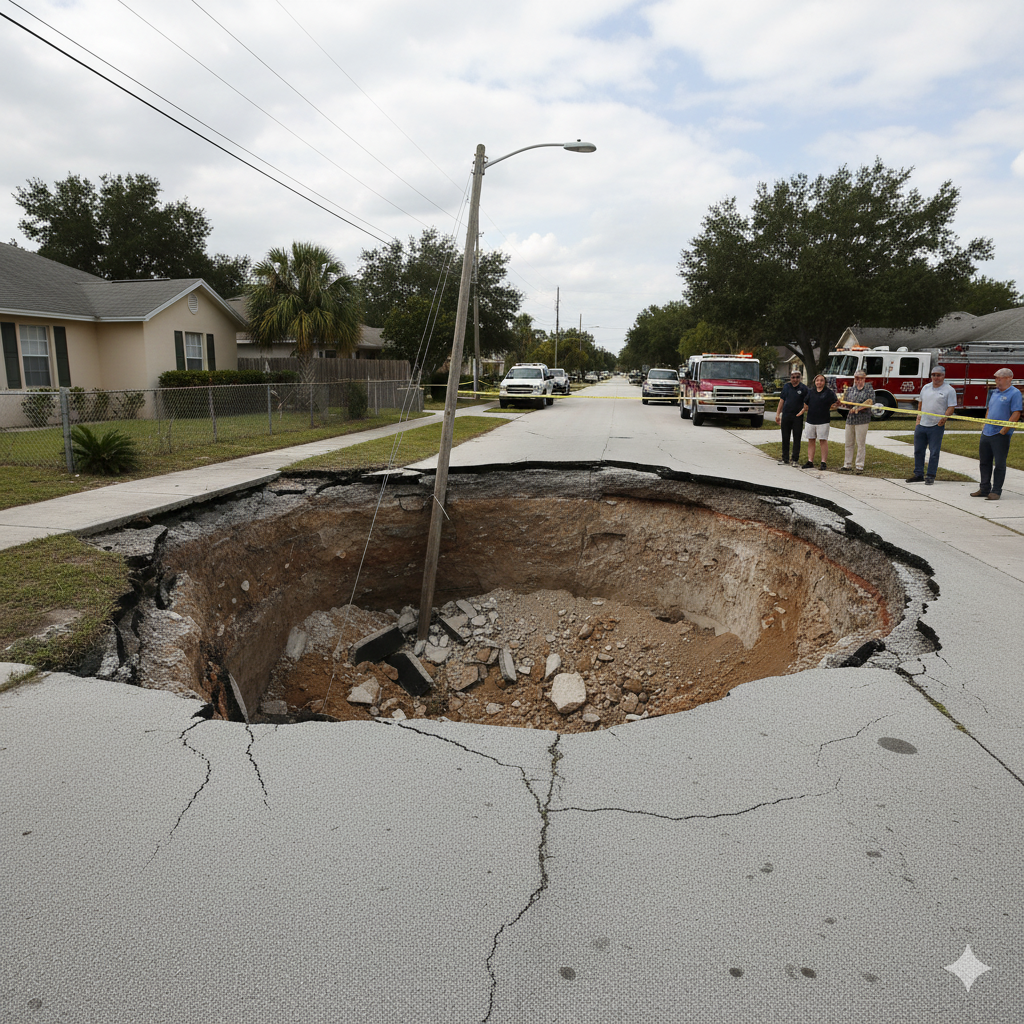
Much of the state sits on a porous limestone platform. Over millions of years, acidic rainwater has dissolved this limestone, creating a hidden, subterranean world of “underwater caves, sinkholes and springs.” This is known as Karst Topography.
In many parts of Florida, there are “hollow caverns” just beneath your feet. Digging deep for a basement is a massive gamble. You could be concentrating the entire weight of your home onto the eggshell-thin roof of an unknown void, making a catastrophic sinkhole all but inevitable.
Shifting Sands and Expansive Clays
The soil above this unstable limestone isn’t much better:
- In North Florida: The soil is full of “expansive clays.” This type of soil acts like a powerful sponge—it swells dramatically when it absorbs water and shrinks when it dries out. This “shrink-swell” cycle puts immense lateral pressure on basement walls, causing them to bow, crack, and collapse.
- In Central and South Florida: The soil is mostly loose sand. This soil has very poor load-bearing capacity and is easily eroded. Water from a heavy storm can literally wash the supporting soil out from under a foundation, causing it to settle, shift, and fail.
3. The Deal-Breakers: Hurricanes, Codes, and Costs
If the hostile geology and hydrology weren’t enough, a combination of extreme weather, legal barriers, and financial traps make a Florida basement a certified “bad idea.”
Hurricanes: A Basement is a Death Trap
A Northerner’s first instinct in a storm—go to the basement—is a life-saving one in a tornado. In a Florida hurricane, that same instinct is life-threatening.
The primary threat from a hurricane is not just wind, but catastrophic water from torrential rain and, more lethally, storm surge. A storm surge is when the hurricane’s winds push a wall of ocean water miles inland.
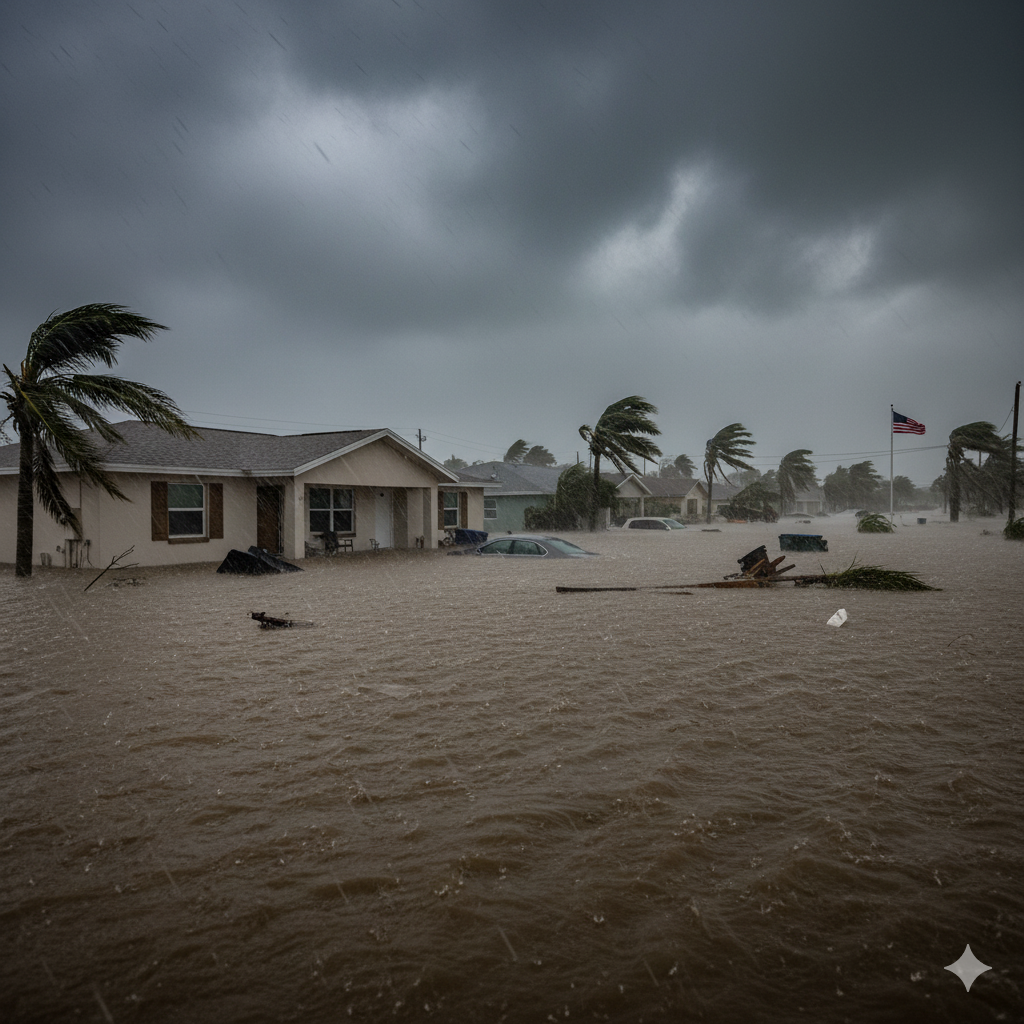
A basement is the lowest point on the property. It is the first place to flood, and it would fill with water “within hours,” turning it into a dangerous trap from which there is no escape.
The Legal Barrier: The Florida Building Code
In most of the state, it’s not just a bad idea to build a basement; it’s legally impossible.
The Florida Building Code, designed to protect homes from flooding, mandates that in flood hazard areas, the “lowest floors” must be elevated to or above the base flood elevation (BFE) plus 1 foot.
Here’s the legal checkmate: The code explicitly defines the “lowest floor” as including the “lowest enclosed area (including basement).”
The Legal Paradox:
- A basement is, by definition, subterranean (below ground).
- The law requires your lowest floor to be elevated (above ground).
It is physically impossible to build a subterranean room that is also elevated, which effectively legislates basements out of existence in most of the state.
The Financial Trap: Cost and Insurance
This is the ultimate “dollar sense” deal-breaker.
- The Missing Incentive (Frost Line): In the North, builders must dig 4-6 feet deep anyway to get below the “frost line” (to prevent freezing ground from heaving the foundation). Since the expensive excavation is already required, digging a few feet more for a full basement is a small, marginal cost. Florida has no frost line, so foundations can be a simple, cheap “slab-on-grade” poured right on the ground.
- The Prohibitive Cost: Factoring in all the engineering, pumping, and waterproofing, a Florida basement can cost between $77,000 and $120,000 or more. This can be one-third the cost of the entire home.
The Insurance “Gotcha”
This is the final nail in the coffin. Even if you paid $100,000 to build a beautiful, finished basement, it is functionally uninsurable.
- Standard homeowners insurance does not cover flooding.
- You must buy a separate flood policy from the National Flood Insurance Program (NFIP).
- The NFIP policy provides extremely limited coverage for basements. It does not cover finished items (like finished walls, flooring, or drywall) or any of your personal belongings (furniture, electronics, etc.). It only covers structural components and essential utilities.
As we cover in our other articles on [flood insurance (link to your article on diydollarsense.com)], the very reason you want a finished basement—for living space—is 100% uninsurable against its number one threat. It is the single worst financial investment a Florida homeowner could make.
Smart Florida-Friendly Alternatives (For Storage and Shelter)
So, what do you do instead? Floridians have adapted by using smart, resilient alternatives.
Solution 1: The “Florida Basement” (Storage)
The “Florida Basement” isn’t a room; it’s a combination of solutions. For homeowners at diydollarsense.com, maximizing space is key.
- Garages: This is the #1 solution. Use heavy-duty overhead ceiling racks for long-term items (holiday decor, hurricane shutters) and wall-mounted cabinets for everything else.
- Attics: Use the truss space for light storage. Be mindful of the heat and humidity.
- Detached Sheds: A well-built, elevated shed is a cost-effective, flood-ready way to add storage.
- Interior Solutions: Maximize closets with organizers and invest in furniture that doubles as storage, like ottomans and platform beds.
Solution 2: The Correct Storm Shelter (Safety)
A basement is the wrong shelter for a hurricane. The right one is an above-ground, FEMA-rated Safe Room.
This is a hardened structure, often built inside a garage or closet, that is anchored to the foundation and engineered to withstand Category 5 winds (200+ MPH) and flying debris. It is designed to save you from wind, not water.
Here’s the final “dollar sense” lesson: Federal programs financially penalize you for having an uninsurable basement (via the NFIP), but they often provide grants (like the Hazard Mitigation Grant Program) to help you pay for the correct solution: a safe room.
Q: Is it illegal to have a basement in Florida? A: In many parts of the state, it is effectively illegal. The Florida Building Code dictates that in flood hazard areas, the “lowest floor” of a home must be elevated above the base flood elevation. Because the code explicitly defines the “lowest floor” to include basements, it creates a legal paradox: you cannot build a subterranean room that is also elevated.
Q: Are basements illegal in Florida? A: While there isn’t a statewide ban on basements, local zoning and strict building codes make them functionally illegal in most areas. The laws are designed to protect homes from severe flooding and storm surges. If a property is located in a designated flood zone, building a basement will violate these mandatory safety codes.
Q: Why do houses in Florida not have basements? A: Florida homes lack basements due to three major factors:
- A High Water Table: The ground is saturated just a few feet below the surface, meaning a basement would constantly fight extreme water pressure.
- Unstable Geology: The state sits on porous limestone (prone to sinkholes) and shifting sands, which cannot safely support a deep foundation.
- Hurricanes & Costs: Basements are lethal flood traps during a hurricane storm surge. Furthermore, Florida has no frost line, making a simple slab-on-grade foundation far cheaper and more practical.
Q: Can any Florida homes have basements? A: While it is theoretically possible in certain highly elevated areas with specific soil types (primarily in parts of Central or North Florida), it is incredibly rare and financially ruinous. Building one requires constant, expensive 24/7 sump pump systems to prevent it from floating or flooding. Even if built, a finished basement is functionally uninsurable against flooding through the National Flood Insurance Program (NFIP), making it a massive financial risk.
Conclusion: Built Smarter, Not Deeper
The lack of basements in Florida isn’t a “quirk” or a flaw. It’s the most visible and logical sign of a building industry that has intelligently adapted to a unique and hostile environment.
Given the impossibly high water table, the unstable “egg-shell” ground, and the catastrophic financial and physical risks from hurricanes, the decision is clear. Florida have smart mobile and modular homes are built smarter, not deeper.
Frequently Asked Questions (FAQs)
Q: Is it illegal to have a basement in Florida? A: In many parts of the state, it is effectively illegal. The Florida Building Code dictates that in flood hazard areas, the “lowest floor” of a home must be elevated above the base flood elevation. Because the code explicitly defines the “lowest floor” to include basements, it creates a legal paradox: you cannot build a subterranean room that is also elevated.
Q: Are basements illegal in Florida? A: While there isn’t a statewide ban on basements, local zoning and strict building codes make them functionally illegal in most areas. The laws are designed to protect homes from severe flooding and storm surges. If a property is located in a designated flood zone, building a basement will violate these mandatory safety codes.
Q: Why do houses in Florida not have basements? A: Florida homes lack basements due to three major factors:
- A High Water Table: The ground is saturated just a few feet below the surface, meaning a basement would constantly fight extreme water pressure.
- Unstable Geology: The state sits on porous limestone (prone to sinkholes) and shifting sands, which cannot safely support a deep foundation.
- Hurricanes & Costs: Basements are lethal flood traps during a hurricane storm surge. Furthermore, Florida has no frost line, making a simple slab-on-grade foundation far cheaper and more practical.
Q: Can any Florida homes have basements? A: While it is theoretically possible in certain highly elevated areas with specific soil types (primarily in parts of Central or North Florida), it is incredibly rare and financially ruinous. Building one requires constant, expensive 24/7 sump pump systems to prevent it from floating or flooding. Even if built, a finished basement is functionally uninsurable against flooding through the National Flood Insurance Program (NFIP), making it a massive financial risk.
Read More from DIY Dollar Sense:
- Home Insurance vs. Home Warranty: The Simple Guide You Need
- Can Modular Homes Have Basements? Yes. Here’s the Pros, Cons & Costs
Do you live in Florida? How do you handle your storage needs? Share your tips in the comments below!




1 comment