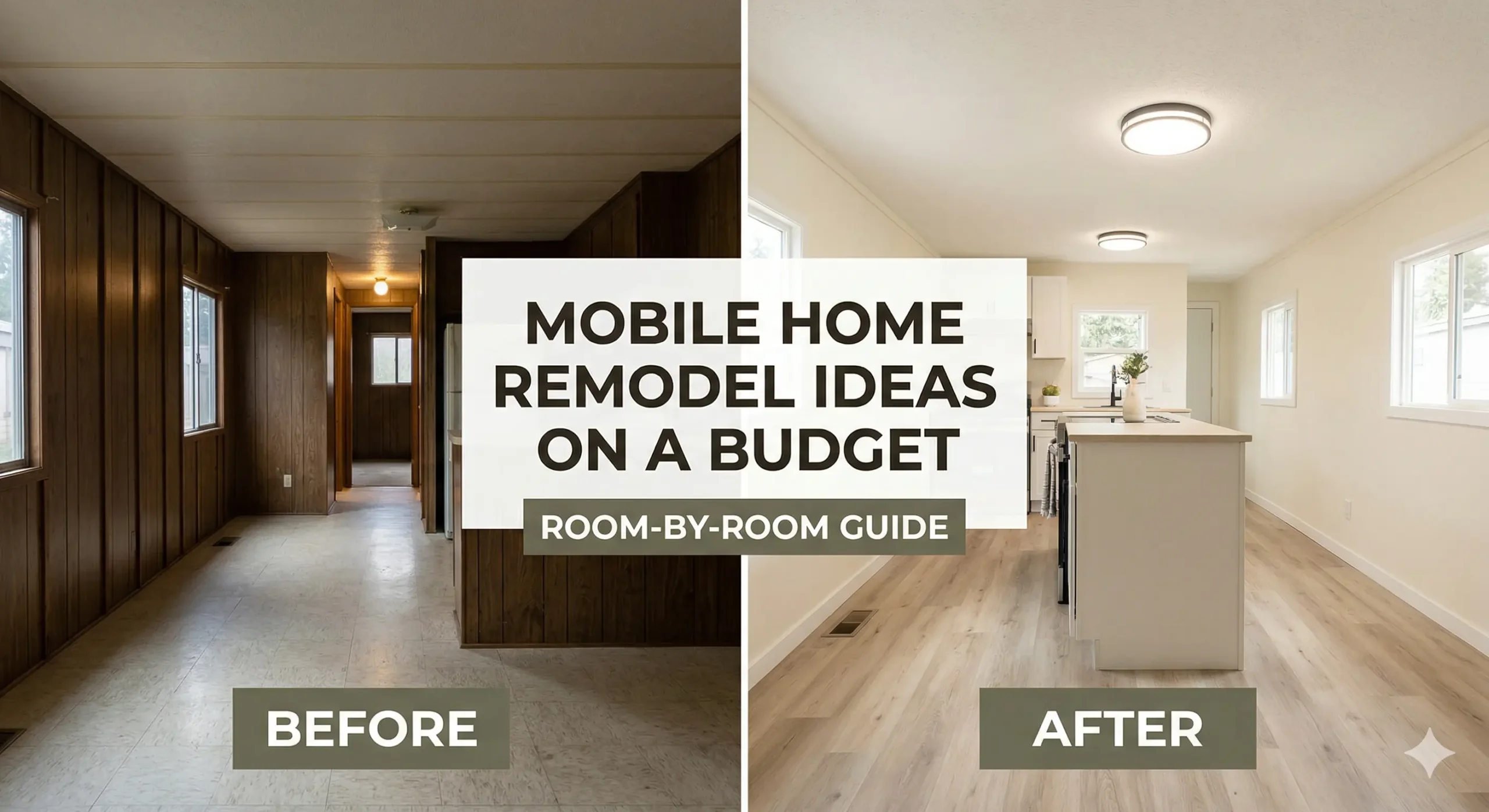
Mobile homes can feel dated, but they’re actually one of the easiest homes to transform on a tight budget because the spaces are small, materials go further, and most upgrades are pure DIY. More than 22 million Americans live in manufactured homes — and smart homeowners are discovering that a few hundred dollars per room can create a space that looks completely modern. The key is understanding what makes mobile homes different: VOG-panelled walls, particleboard subfloors, and non-standard sizing mean the usual big-box advice doesn’t always apply. This room-by-room guide gives you specific, proven ideas with real cost estimates — so you can stop pinning and start doing. Whether you’re starting with the kitchen or tackling the bathroom first, every section below will show you exactly what to buy, what to avoid, and how much to budget.
Quick stats before you start:
Average DIY room upgrade: $150–$450 in materials • Average time per project: 1–2 weekends • Biggest bang for buck: Paint + hardware + flooring
Living room remodel ideas for mobile homes
The living room is the first impression of your home, and in a mobile home it’s often the most challenging space — narrow, linear, and finished with outdated VOG (Vinyl Over Gypsum) panelling covered in vertical batten strips. The good news? Three targeted changes can make it feel completely different.
1. Paint your VOG walls the right way $100–$150 Intermediate
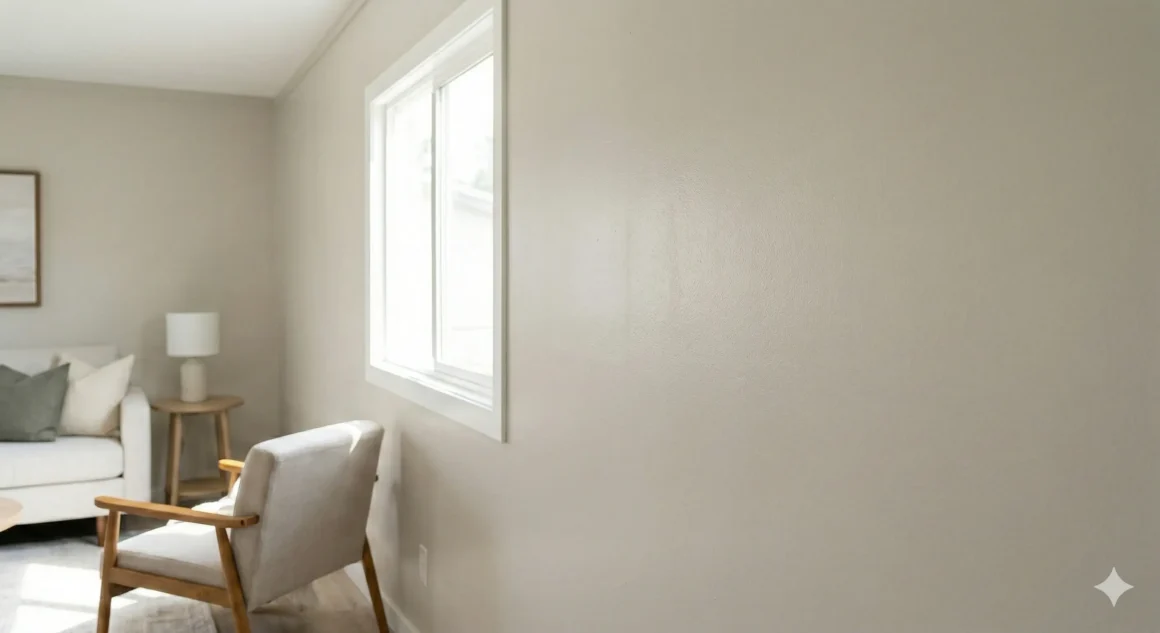
Standard latex paint will peel off VOG panels within months. The fix is simple: use a bonding primer first, then a 100% acrylic latex paint in a light, neutral tone. Acrylic latex flexes slightly with the home’s natural movement (it shifts more than a site-built home during temperature swings), which prevents cracking along the batten seams. Fill seams with elastomeric caulk before painting for a drywall-smooth finish. This single upgrade modernises a living room more than any other change.
📖 Full step-by-step tutorial: How to Paint Mobile Home Walls Without Peeling — covers primer types, batten strip tricks, and the exact products to use.
2. Install floating luxury vinyl plank (LVP) flooring $300–$450 Intermediate
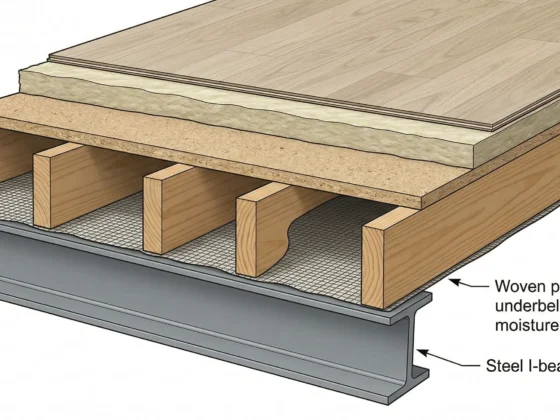
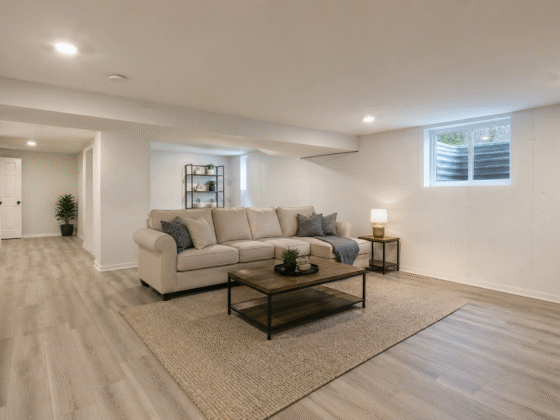
Click-lock LVP is the single best flooring investment for a mobile home living room. It floats above the subfloor (never glue it down permanently), is 100% waterproof, and protects the particleboard underneath from the moisture damage that ruins most mobile homes. For a 200 sq ft living room, budget around $300–$450 in material at $1.50–$2.00 per sq ft. Avoid ceramic tile — the rigid grout will crack as the steel chassis flexes.
3. Add faux wood ceiling beams $150–$250 Beginner
Lightweight polyurethane faux beams add architectural character without stressing the roof trusses. A set of three beams across a single-wide living room ceiling adds instant depth and character for under $250. These weigh a fraction of solid wood, so structural impact is negligible.
📖 More mobile home transformation ideas: 10 Budget-Friendly Ideas to Transform Your Mobile Home Into a Cozy Haven
Mobile home kitchen remodel ideas on a budget
Kitchen upgrades in manufactured homes deliver the highest ROI of any room — but they require specific knowledge. Mobile home cabinets are often built directly into the wall structure at the factory, meaning ripping them out can cause serious damage. The golden rule here is: reface, don’t replace.
1. Paint cabinets and swap hardware $150–$200 Beginner
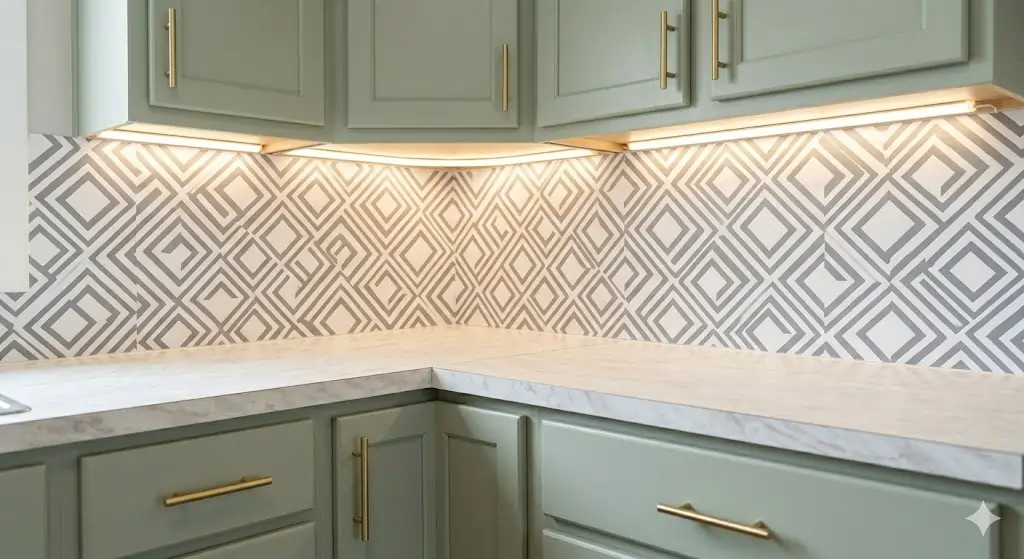
Mobile home cabinet surfaces are typically melamine or MDF — slick, non-porous, and frustrating to paint without the right prep. Liquid deglosser + a cabinet-specific enamel or epoxy paint is the combination that works. Follow with modern brushed gold or matte black hardware from a 20–30 piece bulk pack for a cohesive look. This is the cheapest, fastest upgrade available and transforms the kitchen in a single weekend. Total spend: under $200 for paint kit and full hardware set.
2. Apply a peel-and-stick backsplash $80–$150 Beginner
Traditional ceramic tile and the cement backer board it requires will crack in a mobile home as the walls move. Peel-and-stick vinyl or gel backsplash tiles are specifically designed to flex. They apply directly over existing VOG walls or old tile, require no tools, and can be removed without damage. Choose a heat-resistant adhesive-rated product for the area behind the stove. This upgrade typically takes two to three hours and costs around $80–$150 for a standard mobile home kitchen.
3. Resurface countertops with epoxy $100–$250 Intermediate
Mobile home countertops are usually laminate with an integrated backsplash lip. An epoxy countertop kit mimics granite or marble directly over the existing surface, chemically bonding to the laminate and sealing all joints against water intrusion. It’s the smartest way to protect the particleboard underneath from rot — arguably more important than the aesthetic upgrade itself.
📖 Go deeper on kitchen styling: 10 Affordable DIY Upgrades for a Warm, Neutral Kitchen Makeover
Mobile home bedroom remodel ideas
Bedrooms in single-wide mobile homes average 100–130 square feet — tight, but very workable if you focus on vertical space and visual tricks that open up the room. The goal here is to make it feel like a curated boutique space, not a cramped box.
1. Create an accent wall with peel-and-stick wallpaper or shiplap $100–$200 Beginner
A bold accent wall behind the headboard transforms a bland bedroom without touching a single structural element. Removable peel-and-stick wallpaper is ideal for renters or anyone cautious about commitment. For a more permanent look, lightweight PVC shiplap planks weigh a fraction of solid pine and adhere safely to the VOG wall panels using construction adhesive. One critical note: mobile home wall studs are often 1×3 or 2×3 (thinner than site-built 2×4s) and spaced irregularly, so always use construction adhesive rather than relying on nails alone.
2. Maximise vertical storage $100–$150 Beginner
In a small mobile home bedroom, the floor is your most valuable real estate. Floating shelves, over-the-door organisers, and built-in closet systems draw the eye upward and free up the floor. Anchor shelves directly into studs — not just the panelling — using toggle anchors if a stud can’t be found. Hollow-core floating shelves with hidden internal brackets give a high-end look at low cost.
3. Upgrade lighting with plug-in wall sconces $75–$150 Beginner
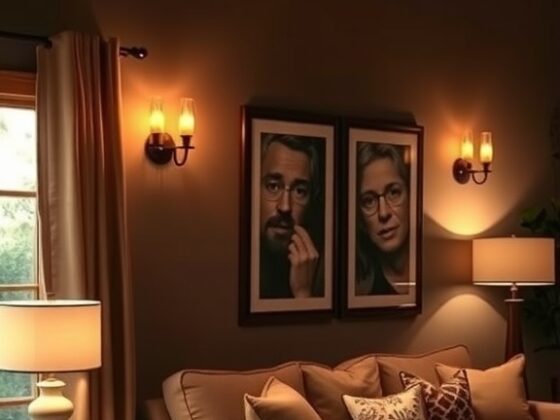
Rewiring a mobile home bedroom is complex and potentially dangerous due to the shallow wall cavities. Plug-in wall sconces completely sidestep this problem — they plug into a standard outlet, mount with minimal hardware, and instantly add warm, layered lighting. Pair with a flush-mount LED overhead fixture (check the junction box weight rating first) to replace harsh builder-grade lighting.
📖 More bedroom inspiration: Aesthetic Small Bedroom Ideas to Maximize Space and Style
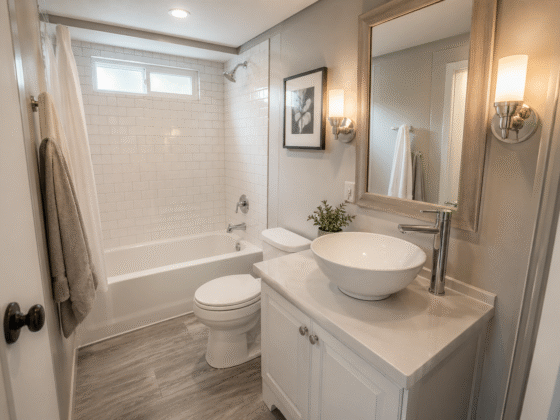
Mobile home bathroom refresh ideas
Bathrooms are where mobile home renovators hit the most structural surprises. Tubs are often non-standard 54-inch lengths (not the 60-inch you’ll find at a hardware store), plumbing comes up through the floor rather than the wall, and moisture is the #1 enemy. These ideas work with those constraints rather than against them.
1. Reglaze instead of replace the tub $75–$150 Intermediate
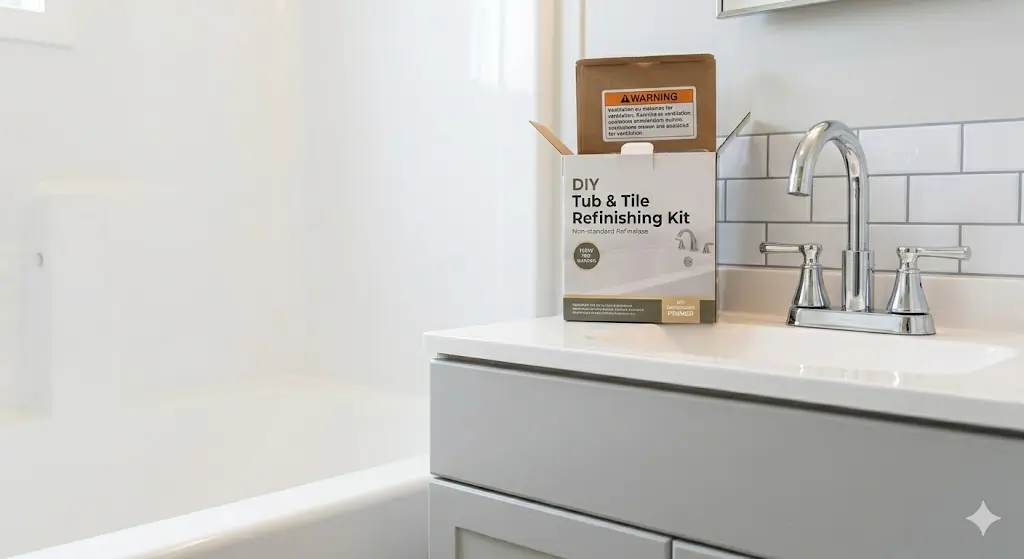
A yellowed or pink fiberglass tub is one of the most common mobile home eyesores — and replacing it is surprisingly expensive and difficult because of the non-standard size. A fiberglass/acrylic refinishing kit restores the tub to a bright white finish that lasts five to ten years with proper care. The kit chemically bonds to the ABS plastic surface and creates a hard, waterproof shell. Ventilate the bathroom thoroughly during application. This is one of the best value-for-money upgrades in any mobile home bathroom.
2. Frame the mirror and update fixtures $100–$200 Beginner
Builder-grade flat mirrors and oxidised plastic faucets are the two biggest sources of the “dated” look in a mobile home bathroom. Building a custom wood frame around the existing mirror (stained to complement your cabinet colour) costs about $30 in lumber and stain. When replacing faucets, measure the hole spacing on your sink first — mobile home sinks are frequently 4-inch centre spacing rather than the widespread 8-inch common in site-built homes. Getting this measurement wrong means an expensive return trip.
3. Swap the showerhead and add peel-and-stick wall tile $80–$150 Beginner
A WaterSense-certified showerhead costs $25–$50 and can cut water use significantly — important for mobile homes on well water systems. Pair this with peel-and-stick waterproof wall tiles applied around the tub surround. These flex with the home’s movement and eliminate the cracking problem that plagues traditional tile grout in manufactured housing.
⚠️ Plumbing warning for older homes: If your mobile home was built between the late 1970s and mid-1990s, it likely has gray polybutylene pipes that are prone to bursting. If you’re remodeling either room, check your plumbing. PEX replacement is the gold standard for mobile homes — flexible, freeze-resistant, and easier to run through the underbelly than rigid copper.
Mobile home exterior remodel ideas
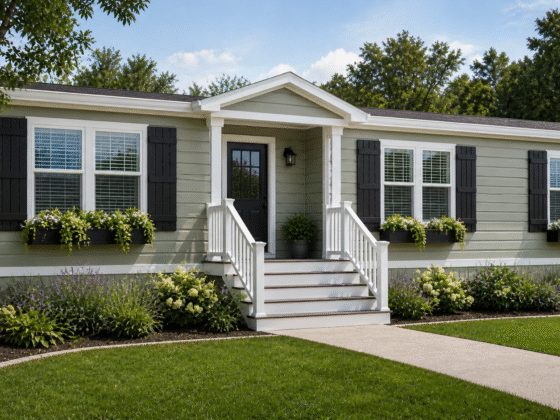
Curb appeal on a mobile home is often overlooked, but it’s the single fastest way to change how the entire property feels — and exterior upgrades also protect the structural integrity of the home. Start here if you’re selling, or if your home’s underbelly is exposed to the elements.
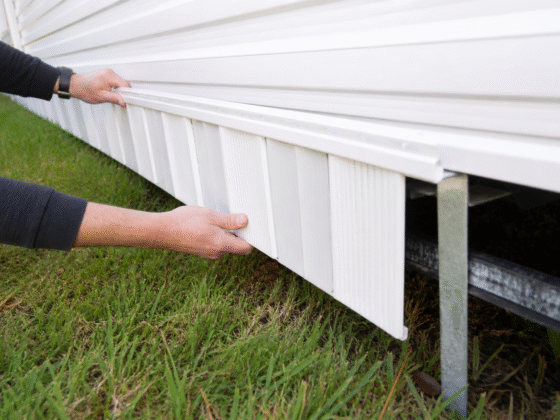
1. Refresh or replace the skirting $100–$250 Beginner
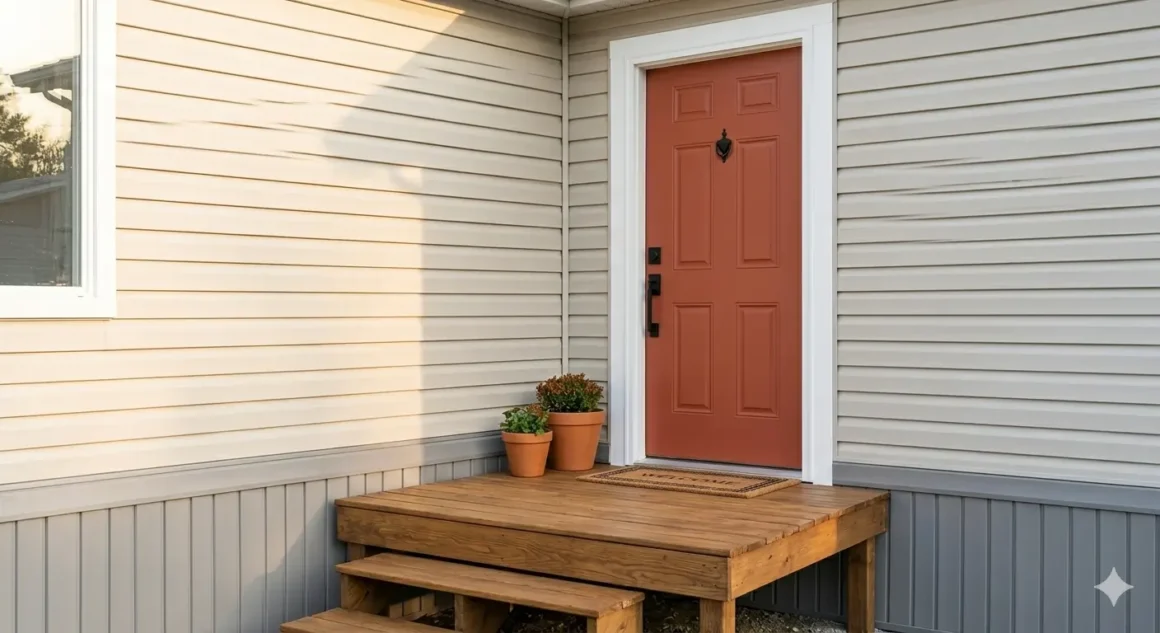
Skirting isn’t just cosmetic — it’s a critical thermal and structural barrier that protects the steel chassis, keeps rodents out, and prevents under-home plumbing from freezing in winter. Power-wash existing vinyl or metal skirting, patch any holes, and apply exterior-grade acrylic paint rated for vinyl or metal. If skirting is missing sections, affordable vinyl skirting kits are available at most mobile home supply stores. Always ensure ventilation panels remain clear to prevent dangerous moisture build-up beneath the home.
2. Paint the front door in a bold accent colour $50–$100 Beginner
Mobile home exterior doors are non-standard sizes (often 32×76 inches), making replacement costly. Painting the existing door is far cheaper and surprisingly impactful. Deep navy, forest green, and terra cotta are all trending accent colours that dramatically increase curb appeal. Use exterior-grade enamel paint for UV resistance, and replace the door hardware and knocker while you’re at it for a complete look under $100.
3. Power-wash and re-stain the deck or entry steps $150–$300 Beginner
A clean, freshly stained deck signals a well-maintained home immediately. Solid-colour exterior wood stain hides deep imperfections and seals against rot. Add solar-powered string lights and a couple of container plants to define the outdoor space. One important note: if adding new deck elements, they must be structurally freestanding from the mobile home. Connecting a heavy deck directly to the chassis can pull the home out of level over time.
Best affordable products for mobile home remodels
These are the specific product categories that work best in manufactured homes — chosen for their compatibility with VOG walls, particleboard subfloors, and the natural flex of a mobile home chassis. All are available on Amazon.
This post contains affiliate links. We may earn a small commission if you buy through our links — at no extra cost to you. We only recommend products we’ve researched for mobile home compatibility.


This post contains affiliate links. We may earn a small commission at no extra cost to you.
Frequently asked questions
How much does it cost to remodel a mobile home?
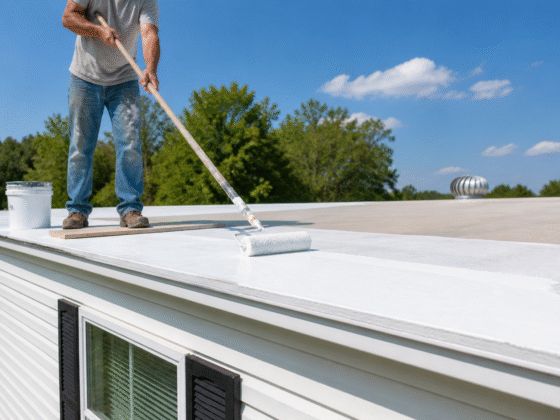
Costs vary widely depending on the scope. Budget-focused cosmetic upgrades — fresh paint, peel-and-stick flooring, new lighting, and updated hardware — can easily be completed for $150–$500 per room in materials. A full home cosmetic refresh covering all five rooms typically runs $2,000–$5,000 when you’re doing the labour yourself. Full-scale renovations that include kitchen cabinetry, PEX plumbing retrofits, or structural subfloor repairs scale up to $10,000–$25,000. The best strategy is a phased approach: tackle the highest-impact rooms first (kitchen and bathroom), use DIY labour for painting and fixture swaps, and reserve contractor quotes for structural work like subfloor replacement or re-roofing. Executing DIY labour can cut total renovation costs by up to 50% compared to hiring out everything.
Is it worth remodeling a mobile home?
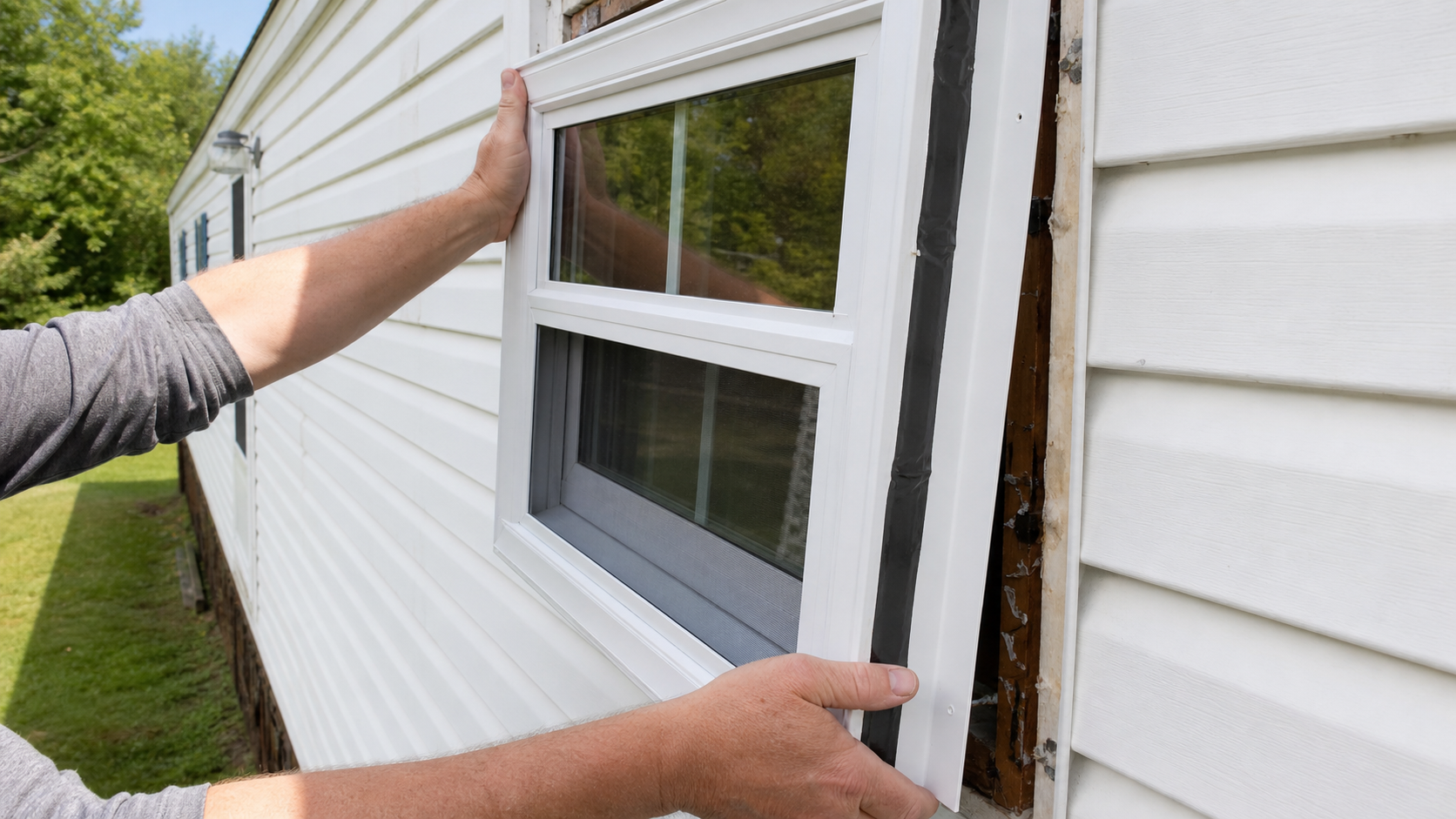
Yes — especially if your home sits on land you own and the structure is fundamentally sound. Strategic upgrades like waterproof LVP flooring, energy-efficient windows, and insulated skirting reduce monthly utility bills, prevent costly moisture damage to the subfloor, and make the home significantly more attractive to buyers when you’re ready to sell. Studies show an 85% satisfaction rate among manufactured home owners, and with over 22 million Americans choosing this housing type, it’s clearly a permanent lifestyle decision worth investing in. The one caveat: if your home is in a leased park and the park is in an uncertain area, prioritise low-cost cosmetic upgrades over major structural investments until your tenure in the park is secure.
What is the cheapest way to update a mobile home?
The cheapest, highest-impact combination is a whole-home paint job paired with a hardware swap — and both can be done in a single weekend for under $300. Apply a bonding primer and acrylic latex paint in a light, neutral tone to your VOG walls to instantly modernise and visually expand the space. Replace cabinet pulls and knobs with a modern brushed gold or matte black bulk set. Swap out dated light fixtures for flush-mount LED panels. If budget allows a third step, layer in peel-and-stick vinyl floor tiles over old linoleum — no tools, no subfloor prep, and transformational results. None of these upgrades require structural changes, permits, or professional help.
Can you drywall a mobile home?
Yes, but not with standard half-inch drywall. Adding full-thickness drywall to a typical single-wide mobile home can add 3,500–5,000 pounds of dead weight — enough to warp the steel chassis and throw the levelling out of alignment permanently. The correct approach is to use lightweight quarter-inch drywall installed horizontally over the existing VOG panelling, secured with drywall screws (not nails, which can pop from the home’s natural flex). Apply elastomeric joint compound over the seams rather than standard rigid drywall mud, which will crack when the home moves. Done correctly, this method gives you a true smooth-wall finish without compromising the structural integrity of the home.
Ready to start? Pick one room, set a budget of $200–$400 in materials, and commit to one weekend. The best mobile home remodel is the one you actually finish — and at these price points, there’s no reason to wait.
📖 Also on DIY Dollar Sense: 10 Creative Entryway Ideas to Maximize Tiny Spaces and Organize in Style — great companion read for making a powerful first impression.


7 comments