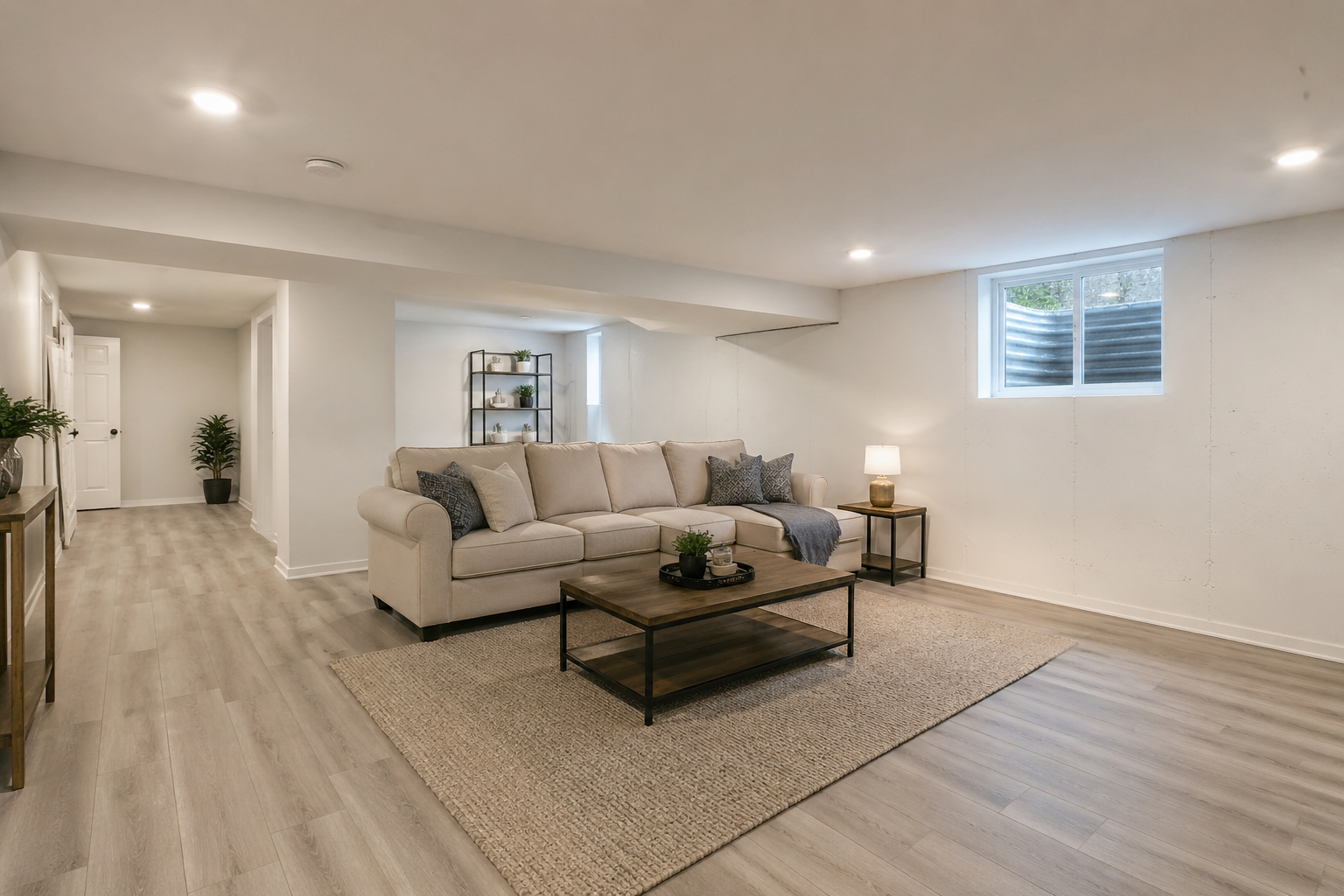
A new poured concrete basement built during initial modular home placement costs $30,000–$80,000. A crawl space runs $8,000–$20,000. Adding a basement after the home is already set — which requires lifting the entire structure — costs $50,000–$150,000+. And in Florida and along the Gulf Coast, a basement is essentially impossible due to the water table.
The right answer for your project depends on four things: whether you’re building new or retrofitting, your soil class, your climate zone, and whether your unit is an off-frame or on-frame modular. This guide breaks all of it down with real 2026 costs and no shortcuts.
In this guide
Can you add a basement to a modular home?
Yes — but only if you have the right type of modular unit. The distinction that matters is modular vs manufactured (mobile), and within modular, off-frame vs on-frame.
Modular homes are built to the International Residential Code (IRC) — the same code as site-built homes. This makes them fully compatible with permanent foundations including basements. Manufactured (mobile) homes are built to the HUD Code and sit on a permanent steel chassis, which makes basement integration far more complex and expensive. If you own a manufactured home, see: can modular homes have basements.
Off-frame vs on-frame — check your spec sheet first
| Feature | Off-frame modular | On-frame modular |
|---|---|---|
| Primary chassis | Removable transport frame only | Permanent steel I-beam |
| Floor joists | 2×10 or 2×12 — strong | 2×6 or 2×8 — shallower |
| Basement compatibility | Full — crane-set directly onto basement walls | Limited — steel frame reduces ceiling height |
| Appraised as | Traditional site-built home | Sometimes appraised as HUD/manufactured |
Off-frame modular homes are by far the better choice for basement integration. After the factory builds the sections, a crane lifts them onto the pre-built foundation walls. The steel transport frame is removed entirely. On-frame units retain their chassis — which can reduce usable basement ceiling height and complicate interior layout unless specifically engineered around the beams.
Always consult a structural engineer before committing to any basement plan. Local building departments in 2026 require certified engineering plans for all basement work under modular homes — this typically costs $2,000–$5,000 but is the primary safeguard against foundation failure, wall bowing, and settlement damage to your home. This is not optional and cannot be skipped.
4 basement types — full cost breakdown (2026)
What affects the cost most — 5 key variables
1. Soil class — the biggest wildcard
| Soil class | Description | Bearing capacity | Cost impact |
|---|---|---|---|
| Class 2 | Sandy gravel | 3,000–5,000 psf | Ideal — minimal extra cost |
| Class 3 | Sand or silty sand | 2,000 psf | Standard cost estimate |
| Class 4 | Clay or silty clay | 1,500 psf | Add $5,000–$15,000 — expansive soil risk |
| Class 5 | Organic or peat | <1,000 psf | Add deep piers — $1,400–$2,100 each |
2. Regional labor rates
| Region | Cost per sq ft (avg) | What drives it |
|---|---|---|
| Northeast | $155–$200 | Union labor, strict codes, deep frost line |
| West Coast | $220–$280 | Seismic codes, severe labor shortage, high land costs |
| Midwest | $100–$150 | Lower cost of living, available labor |
| South | $110–$160 | Competitive rates, hurricane-specific code add-ons |
The same basement that costs $40,000 in Texas can exceed $90,000 in suburban Massachusetts or California. Some jurisdictions also impose “prevailing wage” requirements that increase labor costs by 30–40%. Get at least 3 local contractor quotes before budgeting.
3. Waterproofing — the most commonly skipped cost
Standard “dampproofing” — a thin asphalt spray — is almost always insufficient for a finished basement in 2026. A complete waterproofing system includes an exterior elastomeric membrane, a dimpled drainage board, a filter-fabric-wrapped perforated pipe, and an interior sump pump. Skipping these leads to $5,000–$20,000 in foundation repair costs within the first decade.
4. Permit and engineering fees
Budget $2,000–$5,000 for engineering and permits in most markets — more in urban centers with complex zoning. This is non-negotiable and must be included in every basement cost estimate.
5. Bedrock and utility proximity
If the site has bedrock near the surface, blasting adds $5,000–$20,000. Excavating near existing gas, water, or fiber lines requires hand-digging and spotters — significantly more expensive than standard machine excavation.
Adding a basement after the home is already set
This is a completely different project — and far more expensive
Adding a basement to an existing modular home requires lifting the entire structure with hydraulic jacks — $10,000–$40,000 just for the lift. Total project cost: $50,000–$150,000+. This is typically only justified for high-value properties or critical safety needs (storm shelter in tornado-prone areas).
The house lifting process — step by step
Preparation (1–2 weeks): Tunnels are excavated under the home. All utilities are disconnected. Plumbers and electricians remove any systems hanging below the floor joists.
Lifting (2–7 days): Steel jacking beams are inserted through the tunnels. A hydraulic system lifts the home 1/8 inch at a time — too fast and the structure cracks. The home sits on steel cribbing while the foundation is built.
Foundation construction (4–6 weeks): The basement is excavated and walls are poured while the home is suspended. The home is then lowered onto the new foundation. The home is generally uninhabitable during this entire process.
Crawl space to basement conversion — most viable post-placement option
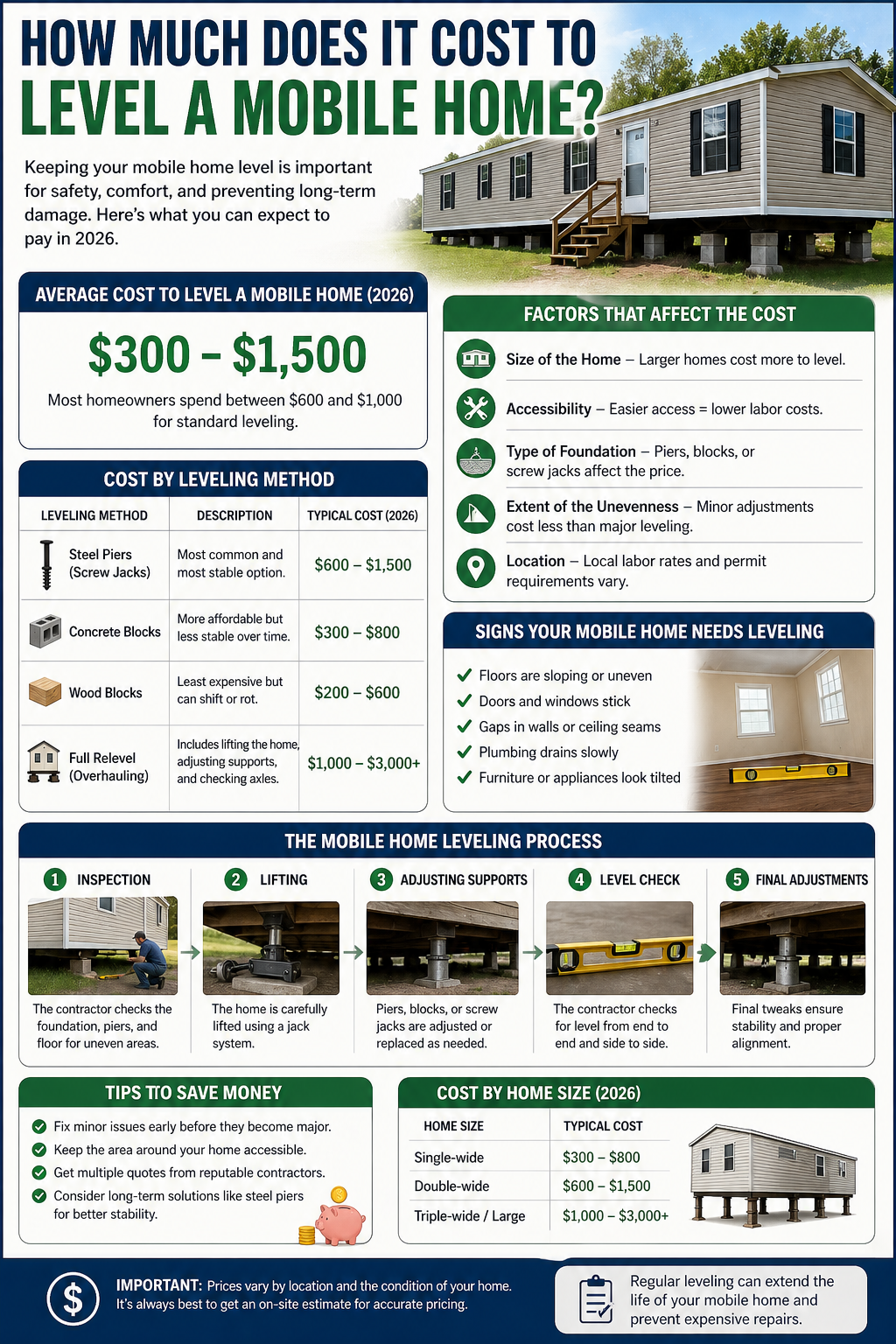
If you already have a crawl space, converting it to a full basement by “underpinning” the stem walls and excavating to 8-foot depth is more viable than starting from scratch. But it’s still expensive — contractors typically quote $80,000–$100,000 for a finished 1,000 sq ft conversion including soil removal and structural supports. This option requires a structural engineer. The leveling implications are significant: how to level a mobile home.
| Scenario | Cost range | Timeline | Verdict |
|---|---|---|---|
| Built during initial placement | $30,000–$80,000 | 2–4 weeks | Best approach — plan ahead |
| Crawl space conversion | $80,000–$100,000 | 6–8 weeks | Most viable post-placement option |
| Full lift and new basement | $50,000–$150,000+ | 4–8 weeks | Only for high-value properties |
Cheaper alternatives to a full basement
For most modular homeowners, these alternatives provide more value per dollar than a full basement — especially if the primary need is storage or an extra room rather than a storm shelter.
Encapsulated crawl space
$12,000–$20,000Best value for most modular owners. Provides climate-controlled storage, protects floor joists, reduces energy bills 10–30%. No structural complexity. Full guide: insulation guide.
Detached garage with storage
$18,000–$50,000Often more cost-effective than a basement — avoids the complexity of supporting the home’s weight during construction. A 24×24 two-car garage provides significant storage and workshop space.
Above-ground room addition
$15,000–$50,000Adds same square footage as a basement bedroom or office — generally easier to permit. No structural lifting required. See the complete addition guide: mobile home addition ideas.
Storage shed
$500–$5,000A professionally installed 10×16 shed on gravel or concrete pad provides ample storage for lawn equipment. No permits in most jurisdictions under 120 sq ft. Best purely budget option.
Interior basement drainage: French drain kit
A perforated pipe and filter fabric French drain system installed along the interior perimeter of a basement floor channels water to the sump pump. The most effective secondary waterproofing measure — and one you can partially DIY before the contractor closes the floor.
Is adding a basement worth it? ROI guide
Basements typically return 50–70% of their construction cost at resale — meaning a $50,000 basement adds $25,000–$35,000 in appraised value. That’s below 100% ROI, which makes the financial case dependent on your specific situation. The complete context for modular home investment decisions: how much does it cost to remodel a mobile home.
✓ Basement makes financial sense when:
Zone 3 (northern) climates — deep footings already required, cost difference narrows
Tornado-prone areas — basement as life-saving storm shelter
Off-frame modular on owned land in appreciating market
When appraising as site-built eliminates “prefab stigma” in the local market
❌ Basement does NOT make sense when:
Zone 1 — Florida and Gulf Coast high water tables make basements impossible or catastrophically flood-prone. This is also why Florida homes don’t have basements
On-frame modular units in low-value markets where the appraisal ceiling limits recovery
Post-placement additions on average-value homes where ROI will never be recovered
The modular advantage: Because modular homes on permanent foundations are appraised identically to site-built homes, a basement removes any “prefab stigma” that some markets still attach to factory-built housing. In markets where that stigma affects the appraisal ceiling, a basement can unlock significantly more value than the raw ROI percentage suggests. The 30% rule applies here — don’t invest more than 30% of the home’s current value in additions and renovations combined if you plan to sell within 5 years.
Frequently asked questions
Can you put a modular home on a basement foundation?
Yes. Modular homes are built to the same IRC standards as site-built homes and are fully compatible with permanent basement foundations. Off-frame modular units are the ideal choice — a crane sets them directly onto pre-built foundation walls after the transport frame is removed. On-frame units retain a steel chassis that can reduce basement ceiling height and complicate interior layout. Always confirm your unit type with the manufacturer’s spec sheet before committing to a basement plan.
How much does it cost to put a basement under a modular home?
Built during initial placement: $30,000–$80,000 for an unfinished poured concrete basement on a 2,000 sq ft home. Add $20,000–$50,000 to finish the space as living area. Post-placement additions — which require lifting the home — cost $50,000–$150,000+. Regional variation is significant: the same basement costs $40,000 in Texas and over $90,000 in Massachusetts or California. Always get local quotes before budgeting.
Can you add a basement to an existing modular home?
Yes, but it requires a specialized house-lifting contractor using hydraulic jacks — $10,000–$40,000 just for the lift phase. The home is generally uninhabitable during the 4–8 week process. The most viable post-placement option is converting an existing crawl space to a full basement through underpinning — typically $80,000–$100,000 for 1,000 sq ft. This is only financially justified for high-value properties or critical safety needs.
What is the cheapest type of basement for a modular home?
A crawl space foundation is the most affordable permanent option at $8,000–$20,000. Among full-depth basements, a concrete block (CMU) basement is typically $5,000–$10,000 cheaper than a poured concrete one — though it requires more intensive waterproofing due to the porous nature of block walls. For pure storage needs without excavation, an encapsulated crawl space at $12,000–$20,000 is the best value option available.
Do modular homes with basements hold their value?
Yes. Modular homes on permanent foundations appreciate at the same rate as traditional site-built homes and are appraised identically. A basement adds habitable square footage and structural durability that supports long-term appreciation. The ROI is typically 50–70% of construction cost — meaning it adds real value but usually doesn’t return the full investment at sale. Markets where “prefab stigma” still affects appraisals benefit the most from basement foundations.
How long does it take to build a basement for a modular home?
A new basement built during initial placement takes 2–4 weeks: excavation, forming, pouring, and 7–14 days for the concrete to reach design strength before the crane sets the home. A post-placement house lift and basement addition takes significantly longer — typically 4–8 weeks — during which the home is generally uninhabitable. A crawl space conversion takes 6–8 weeks for a completed 1,000 sq ft project.
More modular and mobile home guides
Whether you’re building new or upgrading an existing home, the foundation decision is the most important one you’ll make. Plan for it early, budget for waterproofing properly, and get an engineer involved before any ground breaks.