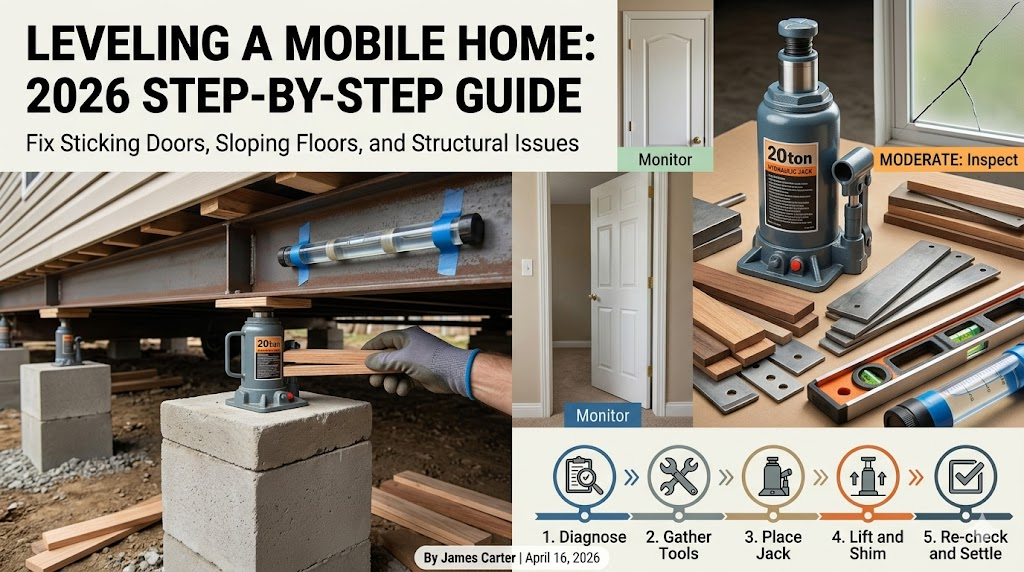
A mobile home that’s out of level isn’t just an annoyance — it’s a structural problem that compounds over time. Doors that won’t latch, diagonal cracks in the drywall, floors that feel like a gentle slope: these are your home’s chassis telling you the piers beneath it have moved. Left unaddressed, an unlevel home develops roof leaks, plumbing failures, and eventually chassis damage that costs thousands to fix.
This guide covers everything you need: how to diagnose the problem, the exact tools required, the step-by-step lifting process, double-wide specific considerations, and when to stop and call a professional.
In this guide
Why mobile homes go out of level: 5 root causes

A manufactured home’s foundation is a floating system — a steel chassis resting on a grid of concrete pier stacks rather than a continuous perimeter footing. This design makes transport possible but means any soil movement beneath a pier translates directly into a twisted or sagging frame. Understanding the cause before you start lifting determines whether a DIY re-level will hold or whether the same pier will sink again in six months.
Soil settlement — the most common cause
Soil bearing capacity varies significantly by type. Dense gravel handles 3,000+ psf; soft clay or sandy silt may provide less than 1,000 psf. Over time, the static weight of your home compresses the soil unevenly — especially if moisture distribution under the home varies. One pier sinks faster than its neighbor, and the chassis begins to twist. Homes on soft clay or uncompacted fill soil are particularly vulnerable.
Frost heave (northern climates)
When groundwater freezes it expands by approximately 9%, forming ice lenses that push piers upward with enormous force. If the footing isn’t buried below the local frost line, the pier lifts several inches in winter then partially drops in spring — but rarely returns to the exact original position. This creates a progressive misalignment over multiple freeze-thaw cycles.
Water erosion under piers
Poor site grading that allows water to pool under the home is destructive. Standing water reduces soil bearing capacity and slowly washes away the fine particles beneath pier pads — a process called subsurface erosion. This creates voids beneath footings that eventually lead to sudden, significant settling. A Florida or Gulf Coast home without proper grading and vapor barrier will experience this regularly. Related: managing moisture under mobile homes in Florida.
Deteriorating pier materials
Concrete blocks are porous — moisture enters, freezes, and spalls the surface. Internally, if the footing contains steel reinforcement, that steel rusts and expands, fracturing the concrete from within. Wood shims made from untreated softwood compress and rot under the continuous load. Over 10–20 years these materials lose the structural capacity they had on installation day.
Poor original installation
HUD Code 24 CFR Part 3285 requires piers within 24 inches of each I-beam end and no more than 120 inches (10 feet) apart center-to-center. Homes installed on uncompacted topsoil containing organic matter, or with undersized footings for the local soil class, are destined to settle. If your home has been unlevel since the first year, this is almost certainly the cause.
How to tell if your mobile home needs leveling — and how serious it is
| Symptom | What it means | Severity | Action |
|---|---|---|---|
| Interior door sticking or swinging open on its own | Minor frame twist (racking) | LOW | Monitor, schedule check within 6 months |
| Diagonal cracks at corners of windows/doors | Active settling underway | MODERATE | Inspect and re-level within 60 days |
| Floor visibly slopes — marble rolls to one side | Significant pier settlement | MODERATE | Re-level within 30 days |
| Marriage line gap (double wide) | Sectional sinking — one half moving independently | HIGH | Immediate action required |
| Buckled or bowed skirting panels | Global chassis descent | HIGH | Immediate action required |
| Slow drains or sewage backup | Slope inversion in drain lines | CRITICAL | Professional inspection today |
The marble test: Place a marble on the floor in the center of each room and observe where it rolls. If it consistently rolls toward the same exterior wall in every room, the center of the home (or the marriage line on a double wide) is higher than the perimeter. If it rolls toward the marriage wall area, the perimeter piers have settled more than the center supports.
Tools and materials you need — and what NOT to use
| Item | Specification | 2026 cost |
|---|---|---|
| Hydraulic bottle jack | 20-ton minimum — provides 2:1 safety factor for most homes | $130–$220 |
| Jack base plate | 12″×12″ steel plate or 2-foot section of 2×12 PT lumber to prevent jack sinking | $10–$25 |
| Water level kit | Superior to laser level in crawl space — works around obstructions | $25–$50 |
| 4-foot carpenter’s level | For interior floor checks and individual pier verification | $25–$45 |
| Hardwood shims | Hardwood only — 30 pack minimum. Never softwood or standard wood shims | $24–$45 |
| Steel shims | Assorted pack for final fine adjustments — most durable long-term option | $50–$100 |
| Solid concrete cap blocks (4″) | HUD Code requires solid cap block at top of every pier stack | $5–$8 each |
| ABS pier pads (16″×18″) | Footing base — rot-resistant composite, replaces wood or concrete pad | $9–$12 each |
| Mechanic’s creeper | For moving safely through the crawl space | $60–$120 |
| Safety PPE | Hard hat, impact eye protection, nitrile gloves, dust mask | $40–$80 |
| Total DIY tool and material cost | $200–$350 | |
❌ Never use these for mobile home leveling:
Standard automotive floor jacks — insufficient load rating and unstable on unpaved ground. Screw jacks — too slow and imprecise. Softwood shims — compress and crush under continuous load. Untreated wood pads — rot within 2–3 years. Standard car jacks are a leading cause of injury in mobile home leveling projects.
Safety warnings — read this before going under your home
⚠️ Critical safety rule: Never enter the crawl space while the home is supported only by a hydraulic jack
If the jack’s seals fail or the ground shifts, the structure will collapse with zero warning. Once a section is lifted, it must be secured with a permanent pier stack or secondary jack stands before any part of your body goes under the I-beam. This is not optional.
Gas lines: Mobile home gas lines use iron pipe or semi-rigid copper. Leveling changes the physical position of all connections. Inspect all gas fittings for flexibility before starting. If you smell gas at any point, stop immediately, leave the area, and call your gas company. Do not proceed until the line has been inspected.
Electrical: Shifting the chassis — especially on a double wide — can pinch wiring or strain the service drop. If you hear any sound resembling electrical arcing during the lift, stop the operation immediately.
Plumbing slope: DWV (drain, waste, vent) pipes require a 1/4 inch per foot slope to function. Aggressive or incorrect leveling can create a “belly” in a drain line that causes chronic backups. Level gradually and check drains before calling the job complete.
HUD Code requirements (24 CFR Part 3285): Piers must be within 24 inches of both I-beam ends. Maximum pier spacing is 120 inches (10 feet) center-to-center. Every pier stack must be topped with a solid 4-inch concrete cap block. Shims must be used in pairs and cannot exceed 1 inch total thickness unless using solid hardwood or steel. Footings must reach below the local frost line.
How to assess your level before touching anything
Before lifting a single jack, you need a complete picture of which piers have moved and by how much. Lifting the wrong pier first can make the problem worse. The water level method gives you a precise map of the entire chassis.
The water level mapping method
Establish your datum point. In the crawl space, identify the pier that appears most stable — typically a central pier on the downhill side of the home. Attach the reservoir end of your water level here. Mark the water line on the I-beam with a wax pencil. This is your reference height for every other measurement.
Map every pier location. Move the measurement end of the tube to each pier one by one. At each location, hold the tube against the I-beam and note where the water line falls relative to the beam. Record this on a hand-drawn diagram of the home — the numbers tell you exactly which piers are low and by how much.
Walk the perimeter. Outside the home, look for buckled or bowed skirting (home has sunk relative to ground), gaps between skirting and the bottom rail (home has risen), and anchor straps that are sagging with no tension (pier beneath has sunk).
Interior double-check: Use your 4-foot level across the floor in multiple directions in each room. A floor that’s level front-to-back but slopes side-to-side indicates one I-beam has settled more than the other. The marble test (placing a marble on the floor and watching it roll) quickly confirms the general direction and magnitude of the slope.
Step-by-step leveling process: single wide
The cardinal rule of mobile home leveling: Always work center-out. Start at the center-most pier on the lowest I-beam, lift, shim, then move outward toward both ends. Never start from the ends — this creates a bow in the chassis that becomes permanent.
Preparation — before the jack goes in
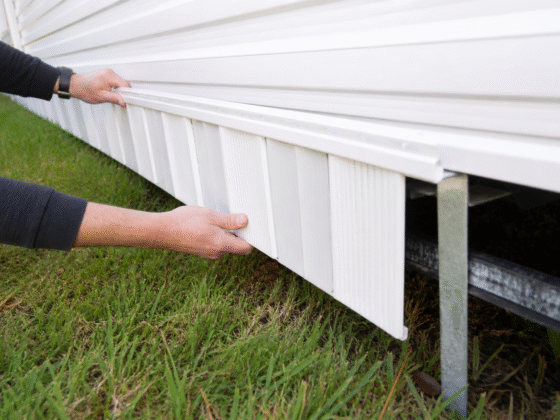
- Remove enough skirting panels to allow full crawl space access and ventilation
- Loosen all anchor straps and bolts — the downward tension will prevent the home from lifting freely and can bend anchor hardware
- Inspect gas, electrical, and plumbing lines under the home — note anything that may need attention before lifting
- Turn off gas at the meter as a precaution if any piping looks corroded or brittle
Positioning the jack correctly
- Identify the lowest pier from your water level map — this is your starting point
- Place the jack directly under the center web of the I-beam — never on the flange edge, which can bend under load
- Set the jack on a 12″×12″ steel plate or 2-foot section of 2×12 pressure-treated lumber to prevent it sinking into soft ground
- Verify the jack is perfectly vertical before pumping — a tilted jack under load will kick sideways
- Pump slowly until the jack makes firm contact with the beam. Pause and check stability before continuing
The incremental lift — the 1/4 inch rule
This is the most important phase. Raise the beam no more than 1/4 inch per session. If a pier needs a full inch of correction, perform it in four separate lifts with observation time between each.
- Watch the pier stack and interior doors as you lift — if you hear loud cracking or see doors racking hard, stop
- Popping sounds are normal; sharp cracking sounds indicate structural stress — stop and assess
- Never place any part of your body under the beam while it’s jacked up without a secondary support in place
Shimming and pier reconstruction
- Once at the target height, insert hardwood shims between the pier cap block and the I-beam in opposing pairs (wedge-to-wedge) to create a flat, level surface
- Hammer shims snug — the goal is to fill the gap, not to drive the home higher with the hammer
- Total shim thickness must not exceed 1 inch unless using solid hardwood or steel spacers (HUD Code requirement)
- If the pier itself is leaning, crumbling, or spalling, the jack must support the weight while you dismantle and rebuild the pier from scratch with a new ABS pad and fresh concrete blocks
Sequence and symmetry
- After adjusting the center pier, move to the next pier toward the front of the home, then the next toward the rear
- Once one I-beam is complete, move to the opposite I-beam and repeat the same sequence
- Alternating between sides prevents the home from racking or twisting along its length
The settle-and-check finalization
- Lower the jacks and allow the home to sit for 48 hours minimum
- New shims commonly compress by 1/8 to 1/4 inch during this period — this is normal
- Re-run the water level test after 48 hours and make any fine-tuning adjustments
- Re-tighten all anchor straps, check all utility connections, replace skirting panels
- Check interior doors and windows — they should operate freely once the home has settled into level
Double wide considerations: the marriage line
A double wide home consists of two independent steel frames joined at the marriage line. This adds significant complexity to leveling because both halves can and do settle independently. For a broader look at how the marriage wall works structurally, see our double wide mobile home interior ideas guide.
Gap at the TOP of the marriage wall
The exterior perimeter piers have sunk. The two halves are tilting away from each other. The home is developing a “V” shape. Fix: raise the exterior piers to bring the outer walls back up to the level of the marriage line.
Gap at the BOTTOM of the marriage wall
The marriage wall center piers have sunk. The home is sagging in the middle. Fix: raise the marriage line piers first, then adjust exterior piers to match.
Double wide leveling sequence: Always level the marriage line first, working center toward the ends. Once the marriage seam is straight and level, adjust the exterior I-beams on each half to match. It may be necessary to temporarily loosen the marriage wall bolts to allow the two halves to realign before re-tightening. Never level a double wide from the exterior inward — this loads the marriage wall before it’s supported and can cause permanent separation.
When to stop and call a professional
Some conditions are beyond DIY territory. If any of the following are present, stop the project and engage a licensed manufactured housing contractor. Note that a home warranty may cover foundation-related work — see does a home warranty cover foundation repair.
I-beam buckling or waviness. If the vertical web of the steel I-beam shows any bowing or buckling, the frame has suffered a structural failure. Lifting on a compromised beam can cause it to fold.
Heavy rust-through corrosion on the chassis. If chunks of the steel frame are missing or you can poke a screwdriver through the metal, the frame’s tensile strength is compromised and may require welded reinforcement before leveling.
Severely fractured concrete footings. Footings cracked into multiple pieces indicate the ground has shifted significantly. The footings likely need to be excavated and repoured before new piers are set.
More than 2 inches out of level across the home. Large corrections require very precise sequencing and carry higher risk of utility line damage. This level of work is best handled by an experienced contractor with commercial-grade equipment.
| Home type | Service level | 2026 cost range |
|---|---|---|
| Single wide | Standard re-level (shim adjustments) | $450–$700 |
| Double wide | Standard re-level with marriage wall sync | $750–$1,200 |
| Triple wide | Standard re-level | $1,200–$2,000 |
| Any size | Complex (pier replacement, excavation, chassis repair) | $2,000–$5,000 |
Preventing it happening again: maintenance and site engineering
Re-leveling fixes the symptom. The following measures address the root causes so you’re not back under the home in two years.
Annual inspection checklist
Check pier plumb — a tilted pier has a fraction of the load capacity of a vertical one and is prone to collapse in high winds
Look for efflorescence (white powdery deposits) on concrete blocks — this indicates chronic moisture migrating through the concrete
Verify the 6-mil poly vapor barrier ground cover is intact — a torn barrier allows significant moisture to migrate into the subfloor daily. For moisture management: managing home humidity
Check anchor strap tension — if straps are slack, a pier beneath has likely moved
Run the marble test in every room — takes 5 minutes and catches problems before they become structural
Site grading and drainage
The fastest way to guarantee your newly leveled home stays level is to keep water away from the piers.
Grading rule
Soil must slope away from the home at minimum 1/2 inch per foot for at least 10 feet from the skirting line
Gutters and downspouts
Clean twice yearly. Downspout extensions must carry roof water at least 5 feet away from the skirting
High water table areas
Install a perimeter French drain to intercept subsurface water before it reaches pier footings
Check frequency
Check level every 3–5 years. New homes: check at 90 days and 1 year for initial soil compaction
Frequently asked questions
How do I know if my mobile home needs leveling?
The most obvious signs are doors that swing open or closed on their own, doors or windows that bind in their frames, and diagonal cracks appearing at the corners of interior openings. You may also feel a general slope when walking across the floor, or notice your plumbing drains more slowly than usual. The marble test — placing a marble in the center of each room — is the fastest at-home diagnostic.
How often should a mobile home be leveled?
Industry standard is a full inspection every 3 to 5 years. New homes should be checked at the 90-day and 1-year mark to account for initial soil compaction under the pier loads. Homes on high clay-content soil or in areas with frequent flooding may need checking every 2 years. Annual visual inspections of the pier stacks and skirting take 30 minutes and catch problems early.
Can I level a mobile home myself?
Yes, if the condition is minor — less than 1 inch out of level — and the foundation components are structurally sound. You’ll need a 20-ton hydraulic bottle jack, a water level, hardwood or steel shims, and a willingness to work methodically in a crawl space. If you find frame damage, severely deteriorated piers, or the home is more than 2 inches out of level, hire a licensed specialist. The safety risks of improper leveling — utility ruptures, structural collapse — are serious.
How much does it cost to level a mobile home?
DIY costs run $200–$350 for tools and materials (jack, water level, shims, pier materials). Professional re-leveling for a single wide costs $450–$700; a double wide with marriage wall synchronization runs $750–$1,200. Complex projects involving pier replacement or excavation can reach $2,000–$5,000. Many homeowners find the professional cost justified given the safety requirements and the precision required to do it correctly.
What happens if you don’t level a mobile home?
An unlevel chassis stresses every connected system. The roof can twist and develop leaks; plumbing drain lines lose their required slope and back up; doors and windows become impossible to open or close. In extreme cases, the steel I-beam itself can develop a permanent set — a bend that cannot be corrected without professional chassis repair. The longer you wait, the more systems are affected and the higher the correction cost.
How long does it take to level a mobile home?
A professional crew completes a standard re-level in 2–4 hours. For a DIY homeowner, expect 8–12 hours of active work spread across two days — the first day for lifting and shimming, then a mandatory 48-hour wait before the final settle-and-check adjustments. Rushing the settle period is one of the most common DIY mistakes; new shims always compress slightly and the home needs time to find its resting position.
More mobile home maintenance and remodel guides
Leveling is the foundation of everything else. Once your home is level and structurally sound, every upgrade you make — new flooring, fresh paint, a kitchen remodel — will perform and last the way it should.






5 comments