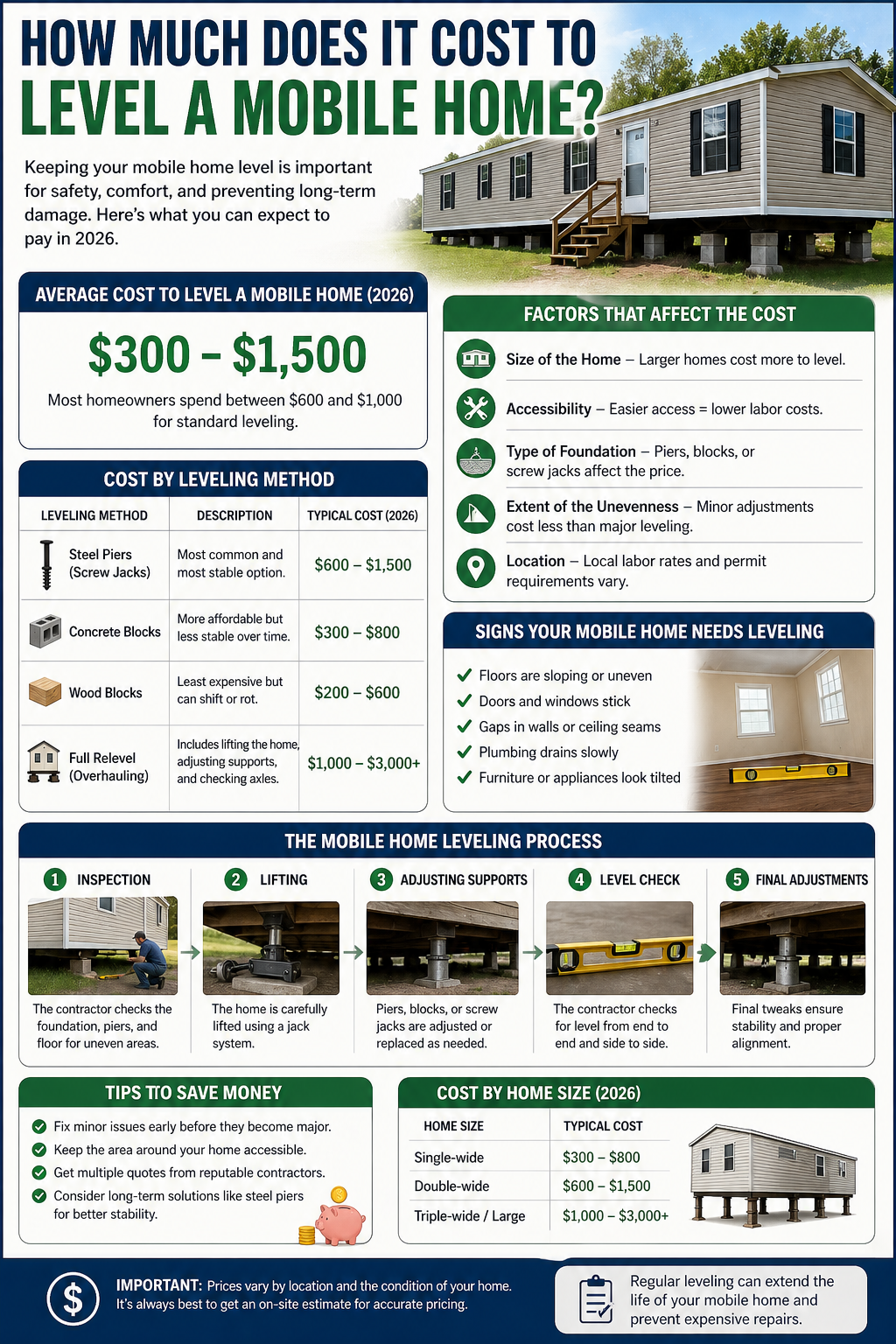
A standard professional re-level for a single wide costs $450–$700. A double wide with marriage wall synchronization runs $750–$1,200. DIY leveling — if the problem is minor and the piers are structurally sound — costs $200–$350 in tools and materials. Complex jobs involving pier replacement or chassis repair run $2,000–$5,000.
This guide breaks down every cost factor, explains when DIY is appropriate and when it isn’t, and gives you the free calculator to estimate your specific job before calling a single contractor.
In this guide
Free leveling cost calculator
Answer three questions to get a ballpark estimate for your leveling job before calling a contractor.
What affects the cost most
1. Home type — biggest single factor
A single wide has one chassis and one set of piers. A double wide has two independent steel frames that must be synchronized at the marriage line — this adds time, complexity, and cost. A triple wide adds another full section. Marriage wall synchronization is the most technically demanding part of any manufactured home leveling job. Full technical guide: how to level a mobile home.
2. Severity of the unlevel condition
Minor corrections under 1 inch are quick shim adjustments. Corrections over 2 inches require multiple careful lift sessions, time to let the home settle, and re-checking — significantly more labor. Over 2 inches also starts to involve risk to utility lines (gas, plumbing, electrical) that must be inspected before and after the lift.
3. Pier condition
If existing piers just need shim adjustments, cost is minimal. If concrete blocks are spalling, footings are cracked, or wood components have rotted, piers must be rebuilt from scratch. Pier replacement adds $50–$150 per pier in materials plus significant labor time — a home with 8 failed piers can jump from a $700 job to a $3,000+ job quickly.
4. Soil conditions and site access
Soft soil (Class 5 — uncompacted fill or peat) requires larger footings and potentially excavation before new piers can be set. Limited clearance under the home slows the work considerably. Homes on sloped lots take longer because pier heights vary significantly across the site.
5. Chassis damage
If the steel I-beam shows buckling, heavy rust-through corrosion, or structural failure, leveling alone won’t fix the problem. Chassis repair or reinforcement by a structural specialist adds $3,000–$10,000+ to the project. This is the scenario that turns a $700 re-level into a $5,000+ job.
Professional leveling cost breakdown (2026)
| Home type | Service level | 2026 cost range | Time on site |
|---|---|---|---|
| Single wide | Standard re-level (shim adjustments) | $450–$700 | 2–3 hours |
| Double wide | Standard re-level with marriage wall sync | $750–$1,200 | 3–5 hours |
| Triple wide | Standard re-level (3 sections) | $1,200–$2,000 | 5–8 hours |
| Any size | Complex — pier replacement or excavation | $2,000–$5,000 | 1–3 days |
| Any size | Chassis damage repair + re-level | $5,000–$15,000+ | Multiple days |
What’s included in a standard professional re-level: Assessment of all pier stacks, water level or laser level mapping of the chassis, shimming and pier adjustment, anchor strap re-tensioning, and a final level verification. Most contractors also provide a written report of any structural concerns found during the job. Always ask for this report — it documents the condition of piers and the chassis for insurance and warranty purposes.
Additional cost items to budget for
| Add-on item | Cost | When needed |
|---|---|---|
| New ABS pier pad (per pier) | $9–$12 | Old wood or failing concrete pad |
| Solid concrete cap block (per pier) | $5–$8 | Required by HUD Code at top of every pier |
| Hardwood shim pack (30-pack) | $24–$45 | Every leveling job |
| Steel shims (assorted pack) | $50–$100 | Best long-term option, Zone 3 |
| New anchor straps (per strap) | $15–$30 | Corroded or loose straps found during inspection |
| Skirting re-installation | $100–$300 | If skirting must be removed for access |
| Structural engineer inspection | $300–$600 | Chassis damage, severe unlevel, insurance claim |
DIY leveling tool and material costs
DIY leveling is appropriate only for minor corrections (under 1 inch) on structurally sound piers. The tools are a one-time purchase that carry over to future maintenance inspections. For the complete step-by-step DIY process: how to level a mobile home.
| Tool / material | Spec | 2026 cost | Note |
|---|---|---|---|
| Hydraulic bottle jack | 20-ton minimum | $130–$220 | Never use automotive floor jack |
| Water level kit | 50 ft minimum | $25–$50 | Superior to laser in crawl space |
| 4-foot carpenter’s level | Standard | $25–$45 | Interior floor checks |
| Hardwood shims (30-pack) | Hardwood only | $24–$45 | Never softwood — compresses and rots |
| Jack base plate | 12″×12″ steel or 2×12 PT lumber | $10–$25 | Prevents jack sinking in soft soil |
| Safety PPE | Hard hat, eye protection, gloves | $40–$80 | Non-optional for crawl space work |
| Mechanic’s creeper | Standard | $60–$120 | Moving safely under the home |
| Total DIY tool and material cost | $200–$350 | One-time purchase | |
DIY vs professional: when each makes sense
✓ DIY is appropriate when:
Home is less than 1 inch out of level
All pier stacks are visually intact — no spalling, no lean
No visible chassis damage — no rust-through, no bowing
Only one or two piers need adjustment
You’re comfortable working in a confined crawl space
⚠️ Always hire a professional when:
Home is more than 1–2 inches out of level
I-beam shows any buckling, bowing, or rust-through
Multiple piers need full replacement
Footings are fractured or ground is saturated
Double wide with marriage wall separation
Home warranty coverage: Some home warranties cover foundation-related work on manufactured homes. Check before paying out of pocket — it’s worth a phone call. More detail: does a home warranty cover foundation repair.
Signs you need releveling — and the cost of ignoring them
| Symptom | Severity | Act within | Cost if ignored |
|---|---|---|---|
| Interior door sticking or swinging open | Low | 6 months | Cracked walls, damaged frames |
| Diagonal cracks at window/door corners | Moderate | 60 days | Structural panel failure, costly wall repair |
| Visibly sloping floor (marble rolls) | Moderate | 30 days | LVP buckling, subfloor damage |
| Marriage line gap (double wide) | High | Immediately | Section separation, roof leak, $5,000+ |
| Buckled or bowed skirting | High | Immediately | Full chassis descent, major structural repair |
| Slow drains or sewage backup | Critical | Today | Health hazard + major plumbing damage |
The cost of waiting: A $700 professional re-level on a mildly unlevel home often prevents $3,000–$8,000 in subsequent damage — cracked VOG walls (see wall repair costs), buckled LVP flooring (see flooring guide), and failed insulation that compounds energy bills. Every renovation you do on an unlevel home degrades faster than it should.
Preventing expensive re-levels — annual maintenance
The $700 re-level is completely avoidable with a 30-minute annual inspection and $200 in preventive site work. Industry standard is checking level every 3–5 years, with new homes checked at 90 days and 1 year for initial soil compaction.
Annual pier inspection
Check for pier plumb, spalling concrete, efflorescence (white powder = chronic moisture), and sagging anchor straps. Takes 30 minutes. Cost: $0.
Site grading
Soil must slope away from the home at 1/2 inch per foot for at least 10 feet. Adding topsoil to regrade a sloped site costs $100–$300. Prevents the water erosion that causes pier settlement.
Gutters and downspouts
Clean twice yearly. Extend downspouts at least 4–6 feet from skirting. Roof runoff pooling at the foundation is the most preventable cause of pier settlement.
Vapor barrier check
Verify the 6-mil poly ground cover under the home is intact. A torn barrier allows pounds of moisture to migrate into the subfloor daily — softening the soil under piers. Related: insulation guide.
Frequently asked questions
How much does it cost to level a mobile home?
Professional leveling costs $450–$700 for a single wide and $750–$1,200 for a double wide in 2026. Complex jobs involving pier replacement or chassis repair run $2,000–$5,000. DIY leveling costs $200–$350 in tools and materials — but is only appropriate for minor corrections under 1 inch on structurally intact piers. The cost of a professional re-level is almost always justified when you consider that an unlevel home accelerates damage to flooring, walls, windows, and doors.
How often should a mobile home be leveled?
Industry standard is a full level check every 3–5 years. New homes should be checked at 90 days and 1 year to account for initial soil compaction under the pier loads. Homes on high clay-content soil or in areas with frequent flooding or freeze-thaw cycles may need checking every 2 years. An annual visual inspection of pier stacks and skirting takes 30 minutes and costs nothing — and catches problems before they require a $1,200 repair.
Can I level a mobile home myself?
Yes — for minor corrections under 1 inch on structurally sound piers. You’ll need a 20-ton hydraulic bottle jack ($130–$220), a water level ($25–$50), and hardwood or steel shims. The total tool investment is $200–$350. The most important safety rule: never place any part of your body under the beam while it’s supported only by a hydraulic jack — always use secondary support first. Full step-by-step: how to level a mobile home.
What happens if you don’t level a mobile home?
An unlevel chassis stresses every connected system. Doors and windows bind and fail. VOG walls crack at seams and corners — see wall repair costs. LVP flooring buckles at the marriage line. In extreme cases, the steel I-beam develops a permanent set — a bend that cannot be corrected without structural repair. Plumbing drain lines lose their required 1/4-inch per foot slope and back up. The longer you wait, the more systems are affected and the higher the total repair cost.
Does homeowners insurance cover mobile home leveling?
Standard homeowners insurance typically does not cover foundation settlement or leveling as a maintenance item. However, if the settlement was caused by a covered peril (like flooding from a burst pipe or storm water intrusion), some policies may cover related damage. Some home warranties do cover foundation-related work — worth checking before paying out of pocket. More detail: does a home warranty cover foundation repair.
How long does it take to level a mobile home?
A professional crew typically completes a standard re-level in 2–4 hours. DIY homeowners should plan for 8–12 hours of active work spread across two days — the first day for lifting and shimming, then a mandatory 48-hour wait before the final settle-and-check pass. Rushing the settle period is the most common DIY mistake: new shims compress slightly and the home needs time to find its final resting position before you can confirm the correction held.
Level first — then upgrade everything else
Every flooring, wall, and kitchen upgrade lasts longer on a level home. A $700 re-level protects thousands of dollars in subsequent renovations.